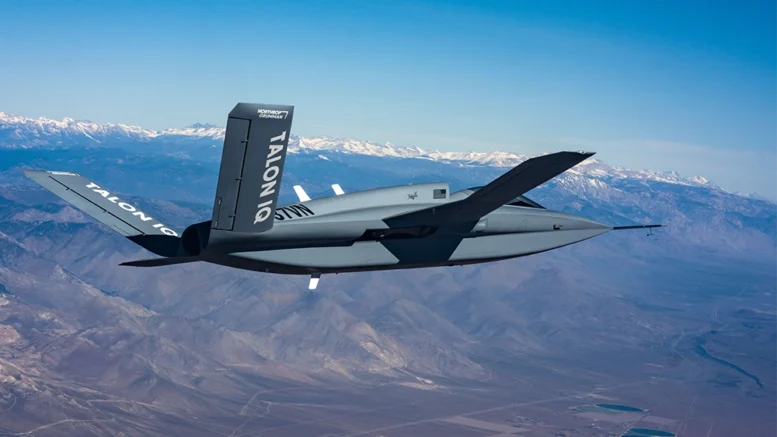
Aviation News – Northrop Grumman’s Talon IQ™ testbed has successfully completed its first partner mission autonomy flight using Shield AI’s Hivemind software. This achievement demonstrates a “plug-and-play” aerial platform capable of rapidly integrating third-party artificial intelligence to accelerate military innovation.
The flight represents a major milestone in the collaboration between defense giant Northrop Grumman and autonomy specialist Shield AI. By utilizing the Talon IQ airframe, the teams bypassed the traditional, costly requirement of building a dedicated aircraft for new software testing. During the demonstration, the Hivemind software successfully commanded the aircraft through complex combat air patrol and target engagement maneuvers, proving that high-level autonomy can be ported to existing hardware with minimal friction.
A key factor in this success was the aircraft’s adherence to U.S. Government Reference Architectures (GRAs). These standards ensure that different defense technology components can interoperate securely and reliably across various platforms. Following the mission, the system showcased its flexibility by seamlessly swapping control from the Shield AI package back to Northrop Grumman’s proprietary Prism autonomy software, confirming that the open-architecture design functions as intended in a real-world environment.
The technical relevance of Talon IQ lies in its ability to dramatically reduce development timelines; in this instance, the Hivemind AI took to the skies after only a single day of hardware-in-the-loop testing. By providing a GRA-compliant ecosystem, Northrop Grumman has created a digital and physical bridge that allows AI packages to move from a laboratory setting to a flight-ready state at unprecedented speed. This operational impact means the military can update “digital brains” without needing to overhaul the physical “body” of the aircraft.
“Talon IQ’s plug-and-play design can host third-party AI platforms and meet U.S. Government Reference Architectures, the standards that ensure defense technology components interoperate securely,” the company noted in a statement highlighting the importance of the open-architecture milestone for future defense readiness.
The success of this testbed signals a shift toward software-defined warfare, where the ability to rapidly iterate on AI will be just as important as the aircraft’s physical performance. Moving forward, the industry will likely see a surge in collaborative flight testing as more partners utilize the Talon IQ to validate autonomous solutions.
Northrop Grumman has effectively lowered the barrier to entry for advanced AI innovation in the aerospace sector. By eliminating the need for dedicated airframes for every new solution, the Talon IQ streamlines the path to a more autonomous and cost-effective air force. This development sets a new benchmark for how the defense industry will develop and deploy next-generation unmanned systems.


