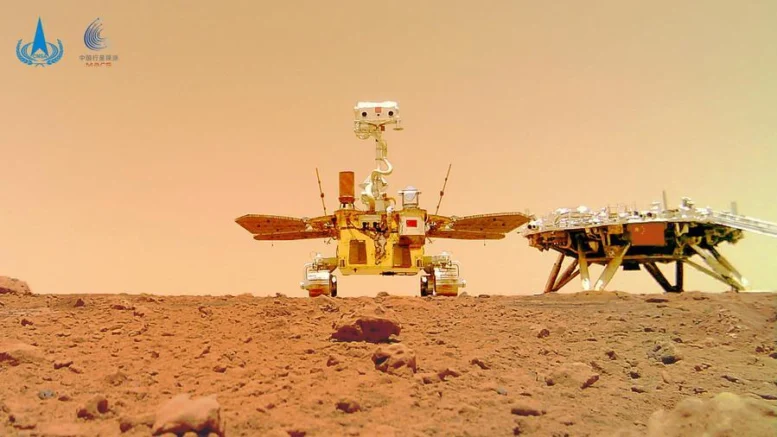
The China National Space Administration (CNSA) has officially selected five international scientific projects to join the Tianwen-3 mission, a historic endeavor to retrieve soil and rock samples from Mars. Announced on Friday in Chengdu, this collaboration marks a significant step in opening China’s deep-space exploration to global scientific contributions.
The selection follows a 2025 call for proposals that offered 20 kilograms of payload space to international partners, drawing 28 applications from across the globe. The final five projects were chosen based on their scientific value, mission support capabilities, and technological maturity. The announcement took place during the opening of the 11th Space Day of China, highlighting the mission’s role within the country’s broader planetary exploration program.
Scheduled for launch around 2028, the Tianwen-3 mission aims to deliver Martian samples to Earth by 2031. The complex architecture of the mission involves a multi-part spacecraft consisting of a lander, ascent vehicle, service module, orbiter, and return module. This structure is designed to handle the intricate sequence of landing on the Red Planet, collecting materials, and executing a precise return journey.
The selected payloads will focus on high-impact research, including searching for signs of life, studying surface minerals, and analyzing the Martian atmosphere. By integrating international instruments—such as spectrometers and laser reflectors—into the orbiter and lander, the mission enhances its ability to map resources and establish precise reference points on the Martian surface.
Looking ahead, the successful integration of these international payloads sets a precedent for future lunar and planetary missions. As the mission enters its prototype development phase, the global community anticipates a wealth of new data that could redefine our understanding of the solar system’s history.
The Tianwen-3 mission represents a major leap in aerospace engineering and international diplomacy. By bringing together experts from various regions, the project aims to solve the technical challenges of interplanetary sample return. Ultimately, these efforts could confirm whether Mars once hosted life, providing a definitive answer to one of humanity’s oldest questions.
Image China National Space Administration (CNSA)