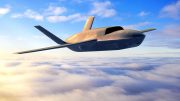
Aviation News – Collins Aerospace, an RTX business, has reached a critical milestone in uncrewed aviation by successfully demonstrating its Sidekick mission autonomy software during a test flight of the YFQ-42A jet. This four-hour autonomous mission, conducted for the U.S. Air Force’s Collaborative Combat Aircraft (CCA) program, marks a major shift toward high-tech human-machine teaming in modern aerial warfare.
The flight test, which took place in early February 2026, utilized the YFQ-42A uncrewed jet developed by General Atomics Aeronautical Systems, Inc. (GA-ASI). By integrating the Sidekick software via the government’s Autonomy Government Reference Architecture (A-GRA), the teams proved that third-party “brains” can be rapidly ported onto different aircraft platforms. This open-systems approach is central to the Air Force’s strategy to field a massive fleet of robotic wingmen that can operate alongside crewed fighter jets like the F-35 and F-22.
During the demonstration, the aircraft engaged autonomy mode for over four hours, precisely executing complex combat-relevant tasks under the supervision of a ground-based human operator. The Sidekick software acts as a mission manager, allowing the uncrewed jet to interpret high-level commands and adjust its behavior based on the tactical environment. This technical capability effectively increases sensor range and weapon effectiveness while reducing the cognitive load on human pilots, who can now command a “swarm” of supporting assets.
“The rapid integration of Sidekick onto this platform to perform various combat-relevant tasks highlight the strength and adaptability of Collins’ open systems approach,” said Ryan Bunge, vice president and general manager for Strategic Defense Solutions at Collins Aerospace. “The autonomy capabilities showcased in this flight highlight nearly a decade of dedicated investment and close collaboration with our customers to advance collaborative mission autonomy.”
The successful test paves the way for the CCA Increment 1 production decision expected later this fiscal year. As the U.S. Air Force looks to build an initial fleet of at least 1,000 autonomous jets, the ability to update software independently of hardware will ensure that these aircraft remain lethal against evolving threats.
Moving forward, the integration of Sidekick suggests a future where uncrewed aircraft are not just remote-controlled drones, but intelligent partners capable of independent tactical decision-making. This evolution will likely define the next generation of air dominance, offering the military “affordable mass” and enhanced survivability in contested environments.