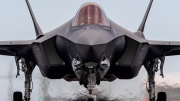
A unique moment in aviation history unfolded on August 27, 2025, when the very first F-35B Lightning II STOVL (Short Takeoff and Vertical Landing) jet, known as BF-01, was delivered to Marine Corps Air Station Beaufort in South Carolina to begin its retirement as a permanent static display.
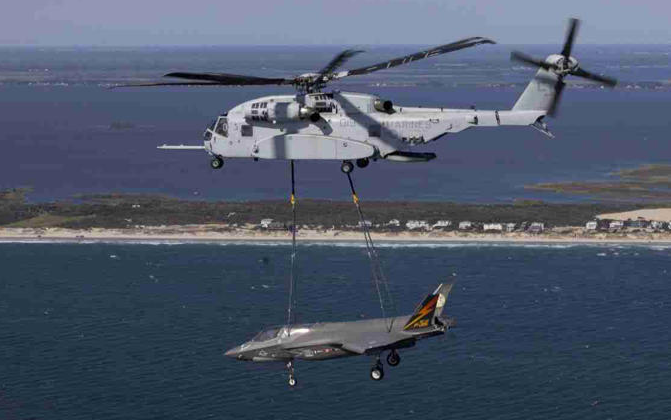
But the delivery was anything but ordinary — the aircraft was transported across 888 kilometers by none other than a CH-53K King Stallion heavy-lift helicopter, the U.S. Marine Corps’ newest and most powerful rotorcraft.
A jet with a historic career
BF-01 isn’t just any aircraft. It was the first F-35B to achieve a vertical landing in 2010 and the first to conduct a vertical takeoff in 2013 at NAS Patuxent River. The jet played a starring role in the developmental test program, logging thousands of flight hours and taking part in key trials aboard U.S. Navy ships, including Phase II sea trials on the USS Wasp in 2016.
Now fully demilitarized — stripped of its engine, stabilizers, and with its lift-fan sealed — BF-01’s next mission is symbolic: to inspire future generations of Marine aviators.
The transport challenge
Moving an F-35 is no small task. The CH-53K King Stallion lifted the 15-ton jet in a meticulously rehearsed external load operation. A second CH-53K accompanied the mission to provide aerial refueling support and backup.
Colonel Matthew Bagley, commanding officer at MCAS Beaufort, praised the mission as an example of precision teamwork, noting the King Stallion’s ability to conduct such complex heavy-lift missions safely and efficiently.
The King Stallion’s growing role
The CH-53K represents a massive leap forward for Marine heavy-lift aviation. With a maximum external payload of 12,200 kilograms (and up to 16,300 kg under certain conditions), digital flight controls, powerful new engines, and a redesigned transmission and rotor system, the helicopter is built to handle the toughest missions — from ship-to-shore logistics to supporting joint operations in austere environments.
The King Stallion is gradually replacing the aging CH-53E Super Stallion, which has faced maintenance and reliability issues for years. Full transition to the CH-53K fleet is expected to continue well into the 2030s, giving the Marine Corps a more capable and survivable heavy-lift platform for future conflicts.
A new era in Marine aviation
For the U.S. Department of Defense, placing BF-01 on display is more than a retirement ceremony. It symbolizes the start of a new chapter: the F-35B as an operational backbone of Marine aviation, and the CH-53K as the enabler of complex missions that connect the fleet, even in the most challenging environments.
As BF-01 takes its place at MCAS Beaufort, it stands as both a piece of history and a symbol of what’s to come.