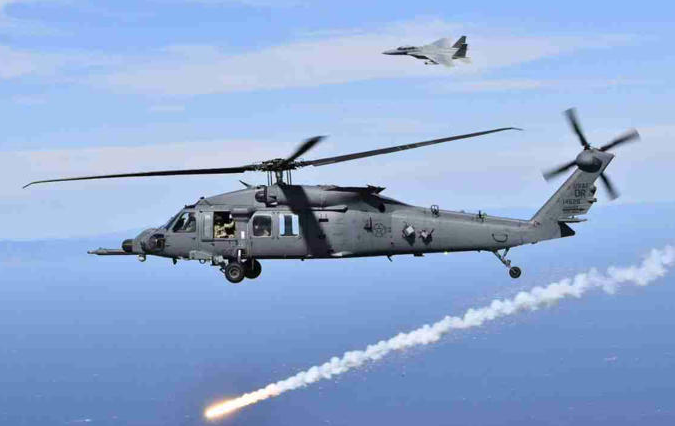
In a unique simulation over the Pacific coast of California, the U.S. Air National Guard and Air Force Reserve staged a scenario straight out of a military thriller: rescue helicopters versus a fighter jet. The exercise was designed to test how well the HH-60W Jolly Green II and its predecessor, the HH-60G Pave Hawk, could defend themselves against the formidable F-15D Eagle in a maritime environment.
Testing defenses against modern air threats
The helicopters deployed electronic countermeasures, including flares and chaff, to simulate how they might survive against advanced air-to-air missile threats. The test was run by the Air National Guard’s Air Guard and Reserve Test Center (AATC), with support from the Naval Air Warfare Center and Modern Technology Solutions Inc. (MTSI), a company specializing in electronic warfare.
What made this exercise stand out was the focus on maritime conditions. Factors like humidity, sea spray, and salt content in the air can affect the performance of defensive systems, and the Pacific theater is seen as a critical environment in any potential high-intensity conflict. The data gathered will help refine both training tactics and future equipment upgrades.
The Jolly Green II: next-gen lifesaver
The HH-60W Jolly Green II, which began entering service in 2022, is steadily replacing the veteran HH-60G. It brings major upgrades, including:
- Extended range and endurance for long-distance rescues.
- Stronger engines and modernized avionics.
- Enhanced armor and survivability features.
- Secure communications systems tailored for modern battlefields.
The aircraft has already proven itself in real-world operations, including a combat rescue mission in the Horn of Africa, underscoring its role as a crucial tool in dangerous environments.
Why this matters
Combat rescue — recovering downed pilots or trapped personnel behind enemy lines — is considered one of the most dangerous missions in the military playbook. Helicopters tasked with this role must often fly low, into heavily defended areas, where the risk of being targeted by enemy aircraft or missiles is high.
By putting the HH-60s against an F-15 in realistic conditions, the U.S. Air Force is preparing for scenarios where rescue missions in the Pacific could become central to future conflicts. With modern great-power competition heating up, ensuring these helicopters can survive and succeed could prove decisive.


