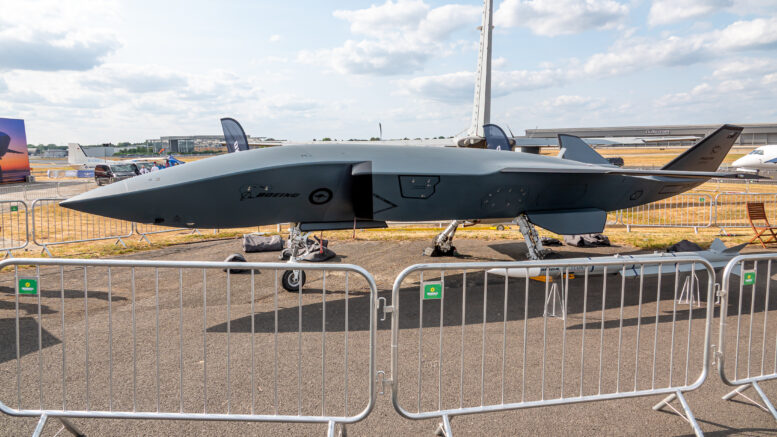
AviationNews – Boeing and allied defense partners have expanded joint network interoperability trials for the MQ-28 Ghost Bat Collaborative Combat Aircraft (CCA). The milestone tests validate the uncrewed platform’s capability to execute autonomous reconnaissance, electronic warfare, and data-sharing missions alongside crewed fighter aircraft in contested airspace.
Originally developed in Australia by Boeing Defence Australia and the Royal Australian Air Force (RAAF), the MQ-28 program has quickly transitioned into a cornerstone for allied loyal-wingman concepts. Building on more than 150 test flights and successful live-fire demonstrations teaming with assets like the E-7A Wedgetail and F/A-18F Super Hornet, the aircraft recently completed extensive international operational evaluations, including deployments for multinational exercises and U.S. flight range testing. Global industrial tie-ups, including a strategic cooperation agreement with Rheinmetall to integrate the MQ-28 for European requirements, underscore growing allied demand for mature, cost-effective uncrewed combat mass.
Technically, the MQ-28 combines a low-observable stealth airframe with an open digital architecture and advanced artificial intelligence for human-machine teaming. A central operational asset is its 2.6-meter modular nose cone, which ground crews can rapidly swap to reconfigure the aircraft for electronic warfare jamming, infrared search and track, or persistent intelligence, surveillance, and reconnaissance (ISR) without structural overhauls. Acting as a forward sensor node, the Ghost Bat fuses battlefield telemetry and relays actionable targeting data across joint datalinks, protecting high-value piloted fighters from enemy air defense envelopes.
“The combination of a highly capable platform, stealth features, advanced autonomy, and artificial intelligence provides unprecedented ability for air forces to extend their mission effectiveness and operational flexibility,” said Brad Thompson, Director for Phantom Works Australia.
As allied air forces seek to counter complex anti-access/area-denial threats, the integration of uncrewed autonomous wingmen will redefine future force structures ahead of next-generation fighter deployments. Military planners and defense ministries must continue aligning cross-domain communication standards to ensure seamless interoperability across coalition networks.
The successful maturation of the MQ-28 Ghost Bat highlights the rapid shift toward distributed air warfare, proving that autonomous systems can reliably share the tactical burden with crewed fighters. As production-representative models advance through joint operational trials, the platform stands at the leading edge of modern military aviation.