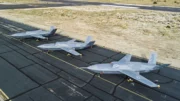
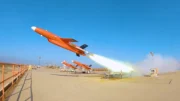
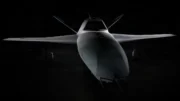
Aviation News – The U.S. Department of the Air Force has successfully conducted the first live-fire testing of the YFQ-44A Collaborative Combat Aircraft (CCA) over the Mojave Desert, marking a major leap forward in integrating autonomous wingmen into modern military operations. This crucial test demonstrates the military’s rapid progress in developing advanced, cost-effective unmanned systems designed to fly alongside manned fighter jets.
During the demonstration in secluded airspace, the YFQ-44A successfully fired an AIM-120 Advanced Medium-Range Air-to-Air Missile (AMRAAM) at a simulated digital target. This landmark event represents a vital phase in a highly structured, step-by-step test progression managed by the military and its industry partners. Earlier evaluations conducted this year focused on inert weapons carriage to collect essential in-flight aerodynamic data and analyze how the aircraft handles under load.
Following those initial captive carry flights, engineering teams carefully validated the critical data link integration between the robotic aircraft and the weapon system. These preliminary milestones proved that pilot commands could travel instantly and securely to the drone. By testing these connections in a simulated environment first, developers ensured that the physical weapons launch would execute precisely as commanded when transitioned to real-world desert test ranges.
Technically, the integration of autonomous flight software with live ordnance represents a massive step in operational flexibility. The CCA program aims to deploy high-performance unmanned aircraft that act as sensor nodes and weapons carriers, dramatically expanding the combat radius and survivability of manned fighters. Operationally, the system relies on a foundational architecture where human oversight remains absolute; the unmanned platform cannot autonomously decide to deploy weapons, ensuring that command and control stay entirely in human hands.
Highlighting the significance of the achievement, Air Force Chief of Staff Gen. Ken Wilsbach stated: “This live-fire test is an important next step in the development of Collaborative Combat Aircraft. We’re one step closer to delivering capabilities to the warfighter.”
Looking ahead, this successful demonstration paves the way for more complex multi-aircraft drills and eventual mass production. Defense planners must now accelerate the refinement of these autonomous systems to outpace evolving global threats. Observers and industry leaders should watch closely as the military transitions these prototypes into active wings, fundamentally rewriting the rules of aerial warfare.
This milestone proves that unmanned wingmen can safely and effectively deploy advanced weaponry under direct human control. By combining artificial intelligence with proven missile systems, the military is rapidly shaping a new era of air combat. The coming years will likely see these collaborative platforms become standard assets in global defense strategies.
SEO & Metadata Options
10 SEO-Friendly Tags:
Collaborative Combat Aircraft, YFQ-44A drone, Air Force live-fire test, AIM-120 AMRAAM, Mojave Desert military test, autonomous wingman, military aviation technology, human oversight weapons, next-gen air combat, Gen Ken Wilsbach,
10 Best Hashtags for X:
#Aviation #USAF #CCA #YFQ44A #MilitaryTech #DefenseNews #AIM120 #AutonomousAircraft #AirCombat #FutureWarfare