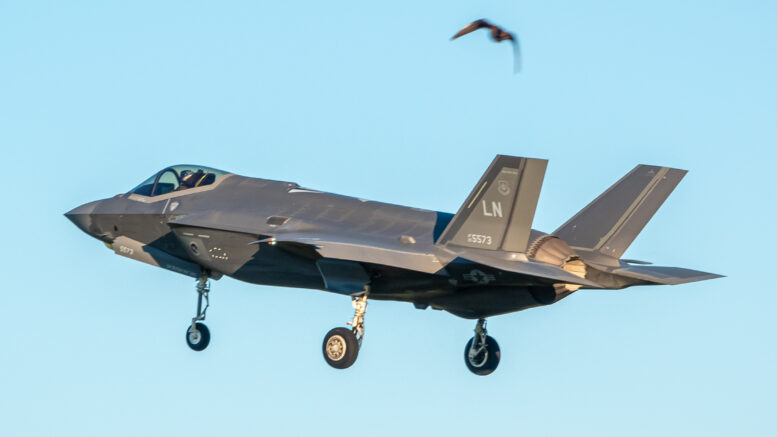
Aviation News – The US Government Accountability Office (GAO) released a verifiably troubling report revealing that the F-35 Lightning II fleet’s full mission capability has plummeted to a critical 25 percent. The steep operational decline leaves the majority of the advanced stealth fighters unable to perform all assigned combat tasks, sparking a major national security and logistics concern.
The investigative report tracks a sharp downward trend over several fiscal cycles, noting that the “fully deployable” rate fell significantly from 38 percent in 2021 down to just 25 percent by the 2025 fiscal year. To counteract these mounting failures, the military requires an estimated 13.7 billion dollars in emergency recovery funds. This massive financial injection aims to bridge severe deficits within the aircraft’s maintenance operations and global supply chain.
Compounding the crisis, the federal watchdog exposed deeply flawed incentive frameworks managed by the Joint Program Office. Due to these weak performance-reward structures, lead contractor Lockheed Martin received millions of dollars in bonuses despite continuously failing to hit basic readiness targets. The contrast between high financial payouts and deteriorating fleet performance highlights a systemic breakdown in contractor accountability.
Air Force officials trace the degraded fleet readiness directly to an accumulation of technical and environmental bottlenecks. Persistent problems with physical corrosion, an acute lack of spare parts, and ongoing software issues heavily impact newer variations of the aircraft. These compounding logistics failures actively prevent localized repair facilities from returning the stealth fighters back to active service in a timely manner.
“Since 2021, F-35 sustainment costs have continued to increase, but the F-35 has not met performance goals and performance has trended down,” the Government Accountability Office stated in its official publication. “Until it ensures the future use of incentive fees better achieves the desired performance, the program increases its risk of continuing to reward contractor performance that does not help meet program goals.”
Resolving these deep-seated supply bottlenecks remains paramount if the military hopes to restore the aircraft to frontline deployment status. The current operational shortfall threatens long-term combat readiness unless the Department of Defense completely overhauls its contractor management systems and restructures its spare parts distribution networks. Lawmakers must now aggressively enforce accountability measures to ensure taxpayer funds directly translate into functional air power.
The persistent degradation of the F-35 Lightning II program represents a profound challenge for modern military logistics. By failing to secure vital technical data and failing to build adequate depot repair capacity, the military has left its premier fighter fleet vulnerable to prolonged groundings. Rectifying a 25 percent fully capable rate will demand years of aggressive supply chain optimization and stricter financial oversight.