viation News – The U.S. Air Force announced plans Monday to deploy at least 500 semi-autonomous Collaborative Combat Aircraft into service by 2032, pairing low-cost uncrewed platforms with traditional fighter jets.
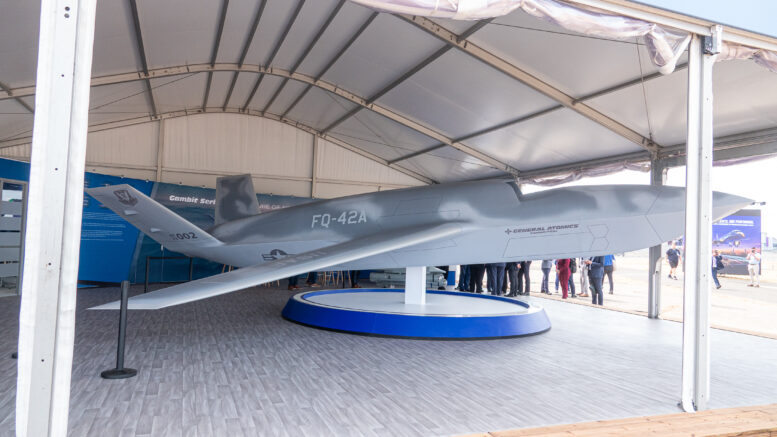
During the Air & Space Forces Association’s Air, Space & Cyber Conference, officials officially named the first two production-bound aircraft designs: the General Atomics FQ-42 Vengeance and the Anduril Industries FQ-44 Fury. The announcement marks a critical transition in the service’s long-term plan to eventually acquire roughly 1,000 combat-ready semi-autonomous aircraft. Building on momentum from June contract awards for aircraft production and mission-autonomy software, the program is rapidly moving toward operational readiness.
The Collaborative Combat Aircraft initiative serves as a core effort to complement human-piloted fighters with scalable uncrewed mass. By integrating lower-cost uncrewed jets alongside crewed platforms, the Air Force aims to distribute tactical risk while increasing frontline presence in contested environments. Both General Atomics and Anduril Industries will manufacture these specialized airframes to support ongoing operational development and flight testing.
Operating as robotic wingmen, the FQ-42 Vengeance and FQ-44 Fury rely on advanced mission-autonomy software to perform complex tasks with minimal pilot intervention. These semi-autonomous platforms fly ahead of piloted jets to extend sensor coverage, carry auxiliary air-to-air weapons, and absorb enemy fire, significantly enhancing situational awareness and fleet survivability.
“Developing semi-autonomous platforms alongside traditional fighters fundamentally expands our tactical options in modern contested airspace,” stated an Air Force official during the conference. “Integrating the FQ-42 Vengeance and FQ-44 Fury ensures our pilots retain superior reach, awareness, and firepower.”
Establishing this uncrewed mass shifts modern aerial tactics away from sole reliance on expensive crewed fighters toward integrated human-machine formations. As manufacturing accelerates, scaled production of semi-autonomous drones will lower per-unit operational costs while providing commanders with flexible combat mass.
The formal naming of the FQ-42 Vengeance and FQ-44 Fury anchors a major transformation in military aviation. Deploying 500 uncrewed platforms by 2032 ensures the U.S. Air Force maintains high-density air coverage. Continued investment in software autonomy and airframe production will ultimately define the future of air superiority.