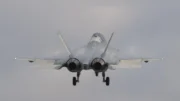
Aviation News – Atlanta-based defense aviation company Hermeus has successfully completed the first supersonic flight of its Quarterhorse Mk 2.1 uncrewed aircraft, hitting a top speed of Mach 1.21. The historic milestone represents a major leap forward for autonomous military technology, proving that private firms can independently field high-speed aviation assets.
The landmark flight took place over the secure White Sands Missile Range airspace, utilizing the facilities at Spaceport America in New Mexico. Hermeus officially announced the supersonic achievement on May 26, 2026, marking a pivotal development context for the U.S. defense sector. Remarkably, the aircraft shattered the sound barrier on just its third test flight, occurring less than three months after its initial airborne debut in early March and exactly 364 days after the company’s very first prototype, the Mk 1, took to the skies.
This rapid progression underscores a highly competitive industry push to deliver scalable, high-speed Collaborative Combat Aircraft (CCA) to the military. Hermeus has structured its development roadmap around rapid, software-backed hardware iterations, funding the multi-aircraft program through private venture capital and strategic partnerships with the Department of Defense. By achieving supersonic velocity within a single year of its flight test campaign, the company establishes a new benchmark for speed in defense procurement, a timeline traditionally measured in decades.
The Quarterhorse Mk 2.1 is roughly the scale of an F-16 fighter jet and utilizes a heavily modified Pratt & Whitney F100 turbofan engine to achieve high-Mach speeds. The uncrewed jet functions as an experimental flight testbed, relying on a ground-based flight deck for remote piloting and real-time telemetry tracking. This technical configuration allows engineers to gather critical aerodynamic data during supersonic transitions, which directly influences the design of the upcoming Quarterhorse Mk 2.2 and Mk 2.3 variants currently under assembly.
“Our customers at the Department of War are paying close attention to how fast this program is moving,” said AJ Piplica, CEO and co-founder of Hermeus. “This flight demonstrates a pace of execution that is extremely rare in modern aviation. Our country‘s ability to deliver new asymmetric military capability at scale depends on teams that can solve hard technical challenges quickly.”
The successful test signals an impending shift toward a decentralized, highly autonomous air defense doctrine capable of countering near-peer adversaries. Moving forward, the introduction of affordable, supersonic uncrewed fleets will allow military commanders to inject mass and rapid response times into heavily contested airspaces without risking human pilots. Aerospace suppliers and engineering teams must now accelerate their production pipelines to keep pace with Hermeus’ aggressive hardware iteration schedule as they push toward sustained hypersonic regimes.
The supersonic triumph of the Quarterhorse Mk 2.1 marks a definitive turning point for autonomous military aviation. By successfully validating its high-speed propulsion and aerodynamic platforms in active flight, Hermeus transitions from a theoretical disruptor into a proven aerospace frontrunner. Ultimately, this milestone establishes uncrewed supersonic flight as a near-term reality, reshaping the future of global aerial combat.