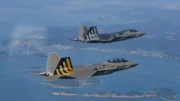
AviationNews – A U.S. Navy F/A-18E/F Super Hornet was recently photographed carrying the rarely seen SLAM-ER cruise missile during an operational flight over Yemen, signaling the employment of highly specific long-range strike capabilities in the volatile region.
The sighting of the sophisticated Stand-off Land Attack Missile-Expanded Response (SLAM-ER) attached to a Super Hornet highlights the specific mission requirements currently facing U.S. forces in the Middle East. The SLAM-ER is an advanced weapon system designed for surgical strikes against high-value, fixed, or moving targets, and its deployment suggests the need to engage targets from beyond the range of enemy defenses while maintaining aircraft safety.
Operationally, the SLAM-ER is a highly accurate, day-and-night, adverse-weather missile capable of being remotely controlled during its terminal phase using a data link pod carried by the launch aircraft. Its stand-off range allows the Super Hornet to fire the weapon from hundreds of miles away, dramatically increasing the survivability of the aircrew while ensuring the precise delivery of its warhead against hardened or politically sensitive sites.
A spokesperson from a naval defense institute commented on the strategic importance: “Seeing the SLAM-ER loadout confirms the Navy is prioritizing precision and crew safety in the current environment. This missile is not a standard load; its use indicates the targeted nature of the operations and the need to neutralize threats from a significant, defensive distance.”
The use of this specialized ordnance underscores the seriousness of the maritime and regional threats emerging from the conflict in Yemen. Future U.S. Navy carrier air wing deployments are likely to continue relying on these long-range precision weapons to safely execute deterrence and defense missions, setting a precedent for engagement protocols in future contested zones.
The observation of the Super Hornet deploying the SLAM-ER is a tangible demonstration of the U.S. Navy’s capacity for high-precision, stand-off strikes in the Middle East. This strategic weapon choice confirms an operational focus on minimizing risk to personnel while effectively degrading emerging regional threats.