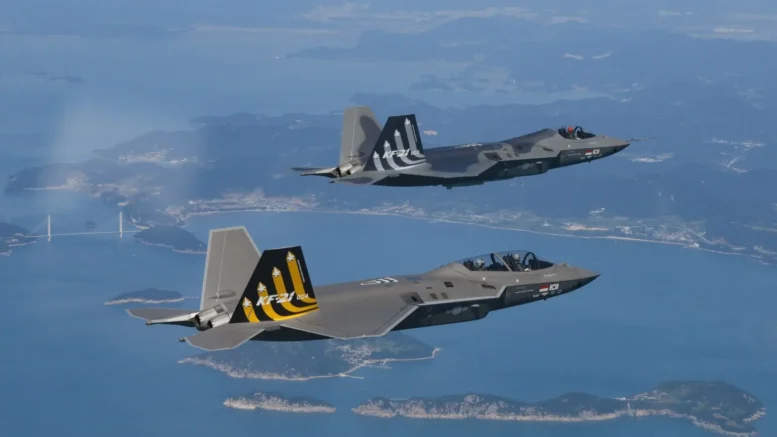
AviationNews – South Korea’s Defense Acquisition Program Administration (DAPA) and Korea Aerospace Industries (KAI) officially concluded the ten-year development phase of the KF-21 Boramae supersonic fighter jet during a ceremony on July 29, 2026. The milestone transitions the indigenous 4.5-generation aircraft program into full-scale mass production and force integration for the Republic of Korea Air Force (ROKAF).
Hosted at KAI headquarters in Sacheon, the ceremony brought together roughly 300 guests, including defense officials, aerospace partners, and international delegates from co-development partner Indonesia. The 8.8 trillion-won ($6.04 billion) development effort formally began in December 2015 to replace aging F-4 and F-5 combat aircraft. Across a rigorous 42-month testing campaign featuring six prototype aircraft, test pilots executed approximately 1,600 flight trials verifying over 13,000 performance conditions without a single accident. The program achieved official combat suitability determination in May 2026 and initial type certification in June after satisfying 745 airworthiness criteria items.
Technically, the twin-engine KF-21 Boramae utilizes two license-built General Electric F414 engines, reaching top speeds of Mach 1.81 with a combat range of 2,900 kilometers and a 7.7-ton weapon payload capacity. The aircraft incorporates a domestically produced Active Electronically Scanned Array (AESA) radar, an integrated electronic warfare suit, and advanced avionics designed for rapid modular upgrades. By mastering the complete design, manufacturing, logistics, and training system, South Korea becomes the world’s eighth nation to independently develop and mass-produce an advanced supersonic fighter.
Reflecting on the milestone during the ceremony, DAPA Minister Lee Yong-chul emphasized the national significance of achieving technological sovereignty: “The success of the KF-21 is a great feat made possible by the blood and sweat of the program stakeholders and the engineers involved in its development, as well as the support of the entire nation,” Lee stated, adding that the achievement proves South Korea’s potential for self-reliant national defense through independent innovation.
Looking ahead, DAPA plans to deliver the first operational production model to the Republic of Korea Air Force in September 2026. The military aims to deploy an initial tranche of 40 air-to-air optimized jets by 2028, followed by 80 enhanced multi-role aircraft equipped with air-to-ground capabilities by 2032 to build a full 120-jet operational fleet. Defense industry partners and international air forces can follow ongoing fleet deployment schedules and export program developments directly through KAI‘s official defense channels.
The completion of the KF-21 Boramae development marks a historic turning point for South Korea‘s defense industrial capability. By transitioning from a military importer to an independent producer of advanced combat aircraft, the nation cements its role as a key player in global defense technology. Continued software enhancements, indigenous weaponry integration, and future AI-driven crewed-unmanned teaming capabilities will ensure the fighter remains at the forefront of regional air superiority.


