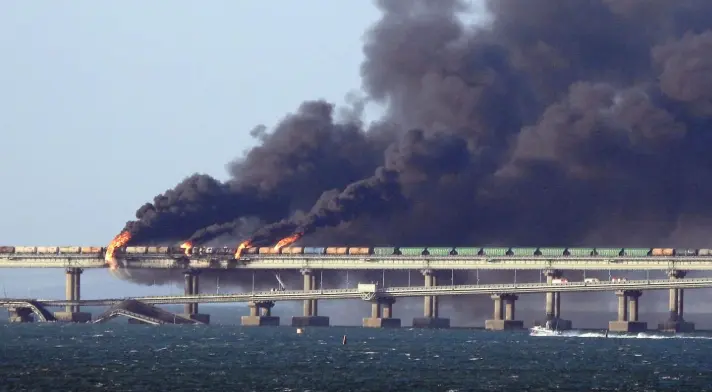
AviationNews – A coordinated Ukrainian aerial and missile strike early on November 17, 2026, collapsed a 227-meter road arch span and severely damaged the adjacent railway section of the Crimean Bridge across the Kerch Strait. The operation was preceded by NATO intelligence, surveillance, and reconnaissance flights over the Black Sea, severing a vital Russian military supply artery.
The overnight assault marked the second consecutive day of Ukrainian strikes against the 19-kilometer crossing linking Russia’s Krasnodar Krai with the occupied Crimean Peninsula. According to Ukrainian President Volodymyr Zelenskyy, the attack concluded the seventh phase of a multi-week campaign that first systematically degraded Russian air defense batteries, radar stations, and electronic warfare systems across the region. Hours before the missiles struck, flight-tracking monitors and military observers noted reconnaissance patrols over international waters in the Black Sea, including a U.S. Air Force RC-135U reconnaissance aircraft alongside a deployed French Navy Atlantique 2 maritime patrol plane operating in the theater.
Ukrainian forces executed a layered saturation strike combining domestically produced Palianytsia, Ruta, and FP-5 long-range drones with Neptune and Flamingo cruise missiles. While Palianytsia drones and Flamingo missiles targeted the vehicular span—sending the massive 227-meter central steel arch crashing into the Kerch Strait—Neptune missiles and Ruta munitions struck the parallel railway deck. Russian occupation authorities immediately halted all road and rail traffic, while fallen steel debris obstructed the main 120-meter-wide shipping channel connecting the Black Sea with the Sea of Azov ports of Mariupol and Berdiansk.
“Our forces systematically destroyed air defense systems, radars, electronic warfare assets, and other designated targets along the path to the final objective,” Ukrainian President Volodymyr Zelenskyy said in a statement confirming the strike. “Using the Flamingo system, our forces executed a precision strike, with the communication link functioning perfectly right up to the final seconds.”
Looking ahead, the collapse of the main navigable arch presents formidable engineering challenges for Moscow, as replacing a custom-fabricated steel span of that scale requires specialized heavy-lift marine cranes and months of uninterrupted work. With both rail and road transit paralyzed and maritime access to the Sea of Azov blocked, Russian forces in southern Ukraine face acute logistical bottlenecks and heightened reliance on vulnerable overland routes through occupied territory.
The November 17 strike demonstrates Ukraine’s growing capability to conduct complex, multi-system precision strikes against heavily defended strategic infrastructure. As repair crews assess the wreckage in the Kerch Strait, the disruption of the Crimean Bridge marks a major operational setback for Russian military logistics heading into winter.