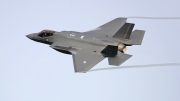
AviationNews – Lockheed Martin has officially rolled out the first F-35A Lightning II for the German Air Force during a ceremony at its Fort Worth facility in Texas, marking a pivotal modernization milestone for European NATO air defence. The handover launches the initial training phase for German flight and ground crews as Berlin prepares to replace its legacy strike fleet with next-generation stealth capabilities.
The aircraft, bearing the German military registration 35+01, took its maiden flight on September 8 before its official presentation on September 18 before senior German and American defence officials. It represents the first airframe delivered from a December 2022 procurement contract for 35 fifth-generation conventional takeoff and landing jets. Rather than flying immediately to Europe, the inaugural jet and seven subsequent aircraft will deploy to Ebbing Air National Guard Base in Fort Smith, Arkansas, where Luftwaffe pilots and support crews will begin specialized instruction this autumn under the Tactical Training Command.
Technically, the F-35A provides low-observable radar deflection, advanced electronic warfare architecture, and an integrated multi-spectral sensor suite that compiles disparate battlefield intelligence into a unified operational display. For Germany, the stealth platform assume the primary role long held by the ageing Panavia Tornado fleet: fulfilling the nation’s nuclear sharing commitments under NATO doctrines alongside tactical reconnaissance and strike operations. Stationed permanently at Büchel Air Base starting in late 2027, the fleet will establish initial operational capability by 2029 before transitioning to full service by 2030.
“The presentation of the first F-35A is the beginning of a new era for the German Air Force,” said German Defence Minister Boris Pistorius at the unveiling. “The F-35A is the world’s most advanced combat aircraft, offering unmatched stealth capabilities, platform integration, and sensor technology that give our forces a decisive edge and reinforce our collective allied deterrence.”
Looking to the future, the arrival of the Lightning II will embed the German military into a synchronized network of more than a dozen European allies operating the same airframe, streamlining parts supply chains, joint tactics, and shared airspace management. Allied air arms and coalition partners will monitor training progress in Arkansas as the transatlantic training hub ramps up throughput ahead of European basing.
The delivery of 35+01 confirms Germany’s accelerated push to modernize front-line combat aviation while meeting its strategic commitments within NATO. As crew training begins at Ebbing, the program solidifies a multi-decade technological transition that ensures the Luftwaffe remains equipped for high-end contested environments.