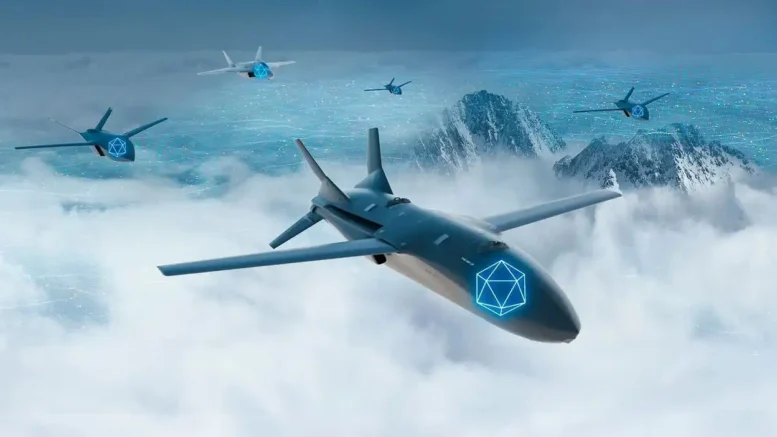
AviationNews – Airbus Defence and Space has successfully demonstrated its new Mindshare mission autonomy software, marking a definitive shift toward a software-defined battlespace where crewed and uncrewed platforms operate as a unified force. By enabling uncrewed aerial vehicles (UAVs) to execute complex, synchronized missions with minimal human oversight, the system effectively decouples tactical logic from hardware, allowing military capabilities to evolve at “software speed.”
The breakthrough follows a landmark joint surveillance mission conducted in late 2024, involving UAVs from the Czech firm Primoco. Unlike traditional drones that require constant remote piloting, these units utilized AI-enriched autonomy to collaborate seamlessly in real-time. This development is part of a broader European effort to integrate crewed platforms, such as the Eurofighter, with autonomous wingmen to overwhelm adversary defenses through increased combat mass and faster decision-making cycles.
At the heart of this digital transformation is a three-tier “biological” architecture designed by Airbus. The “Mindshare” software acts as the brain, providing teaming logic and mission orchestration; the MARS (Multiplatform Autonomous Reconfigurable and Secure) architecture serves as the body or onboard computing power; and the Crossbond system functions as the nervous system, ensuring secure connectivity and interoperability across the fleet. This ecosystem allows pilots to shift from direct flight control to high-level strategic orchestration, reducing cognitive load while maintaining ethical oversight.
“We are moving from platform-centric development to software-centric capabilities,” stated Robert van Tilborg, Head of Business Development for Future Air Power at Airbus Defence and Space. He emphasized that by decoupling software from hardware lifecycles, air forces can now upgrade critical operational functions in “months, weeks, or even days rather than decades,” ensuring they stay ahead of evolving threats.
The deployment of these autonomous systems is expected to become a cornerstone of European strategic autonomy, reducing reliance on non-European digital frameworks. As the “System-of-Systems” integrator, Airbus is positioning this technology to be the operational “glue” for future air operations, where superiority is defined by the speed of the OODA loop (Observe, Orient, Decide, Act).
This transition to collaborative combat represents a fundamental change in modern warfare, moving away from fragmented, hardware-heavy platforms toward an integrated, AI-driven network. By empowering commanders with resilient, scalable drone swarms, Airbus is ensuring that future air forces can penetrate dense air defenses with significantly lower risk to human life.