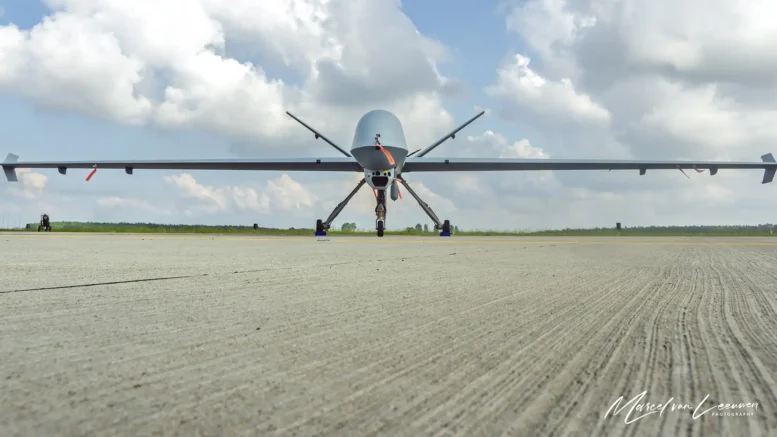
AviationNews – In a strategic move to strengthen regional presence, the U.S. Marine Corps has officially operationalized a new MQ-9 Reaper drone unit within the Indo-Pacific theater.
This deployment significantly enhances American capabilities in maritime domain awareness and targeting across the contentious South China Sea region, signaling a robust response to evolving security challenges in the Pacific.
This activation aligns with the Corps’ broader modernization strategy, often referred to as Force Design 2030, which prioritizes agile, distributed operations over traditional heavy ground forces. The establishment of this specific unit marks a pivotal shift from the Reaper’s historic role in counter-insurgency support to high-stakes littoral operations in contested waters. By positioning these assets forward in the Pacific, military planners aim to counter rising tensions and ensure open access to international waterways, directly addressing the complex geopolitical landscape of the region.
Technically, the MQ-9 Reaper is a medium-altitude, long-endurance (MALE) unmanned aerial vehicle, revered for its ability to loiter for extended periods. In this maritime context, the aircraft are equipped with specialized multi-mode radar and advanced electro-optical sensors designed to detect, classify, and track surface vessels over vast ocean distances. This data feeds directly into the joint force network, providing real-time intelligence that links sensor-to-shooter capabilities, allowing for rapid decision-making and precise targeting coordination with naval assets.
Highlighting the operational necessity of this deployment, a Marine Corps spokesperson emphasized the tactical advantage gained. “Deploying the MQ-9 Reaper to this theater provides our expeditionary forces with persistent, reliable eyes in the sky,” the official stated. “This capability is essential for maintaining continuous situational awareness and ensuring our ability to deter aggression and project power effectively in a dynamic maritime environment.”
Looking ahead, the operational success of this unit is expected to serve as a blueprint for future unmanned deployments in the Asia-Pacific. It represents a move toward more resilient, island-based force structures that reduce reliance on large, vulnerable airbases. As the Marine Corps continues to integrate autonomous systems, this model will likely expand, influencing how the U.S. and its allies approach defense cooperation and surveillance across the vast distances of the Pacific.
This strategic deployment cements the role of unmanned systems in the future of naval warfare. By integrating advanced surveillance into fleet operations, the Marine Corps is adapting to modern threats and ensuring a persistent watch over critical global trade routes.