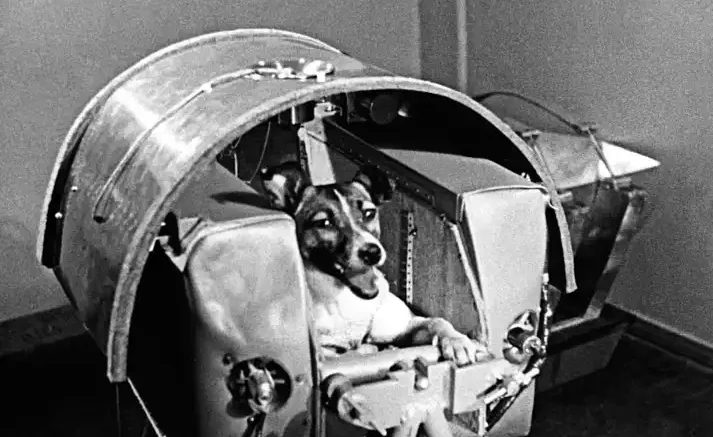
AviationNews – Today, November 3, marks the 68th anniversary of a monumental and tragic milestone in the history of spaceflight. On this day in 1957, the Soviet Union launched the Sputnik 2 satellite, carrying a small dog named Laika who became the first living creature to ever orbit the Earth.
The mission was a stunning political and scientific victory for the Soviet Union, coming just one month after the world-changing launch of Sputnik 1. Laika, a young, mixed-breed stray rescued from the streets of Moscow, was chosen for the mission. She was placed in a pressurized capsule launched from the Baikonur Cosmodrome, designed to test the viability of sending a living being into space and paving the way for human flight.
The Sputnik 2 capsule was a sophisticated piece of technology for its time, equipped with an air regeneration system, a feeding mechanism, and sensors to monitor Laika’s heart rate, respiration, and blood pressure. The mission, however, was infamously a one-way trip; no re-entry or recovery technology had yet been developed. For decades, Soviet officials claimed she died painlessly in orbit a week after launch. However, it was revealed in 2002 that Laika actually died from overheating and stress just a few hours into the flight, likely during the fourth orbit, when the thermal control system failed.
The mission’s legacy is one of both triumph and tragedy, providing invaluable data while raising profound ethical questions. Dr. Oleg Gazenko, one of the mission’s lead scientists, expressed deep regret decades later. “Work with animals is a source of suffering to all of us,” he stated in 1998. “The more time passes, the more I’m sorry about it. We shouldn’t have done it.”
Laika’s sacrifice was not in vain. The data gathered from her flight provided the first proof that a complex organism could survive the conditions of launch and weightlessness. This data was fundamentally critical to the development of the Vostok program, which would successfully launch the first human, Yuri Gagarin, into orbit less than four years later.
Today, Laika is remembered as a reluctant pioneer who opened the door to the cosmos for humanity. Her flight confirmed the viability of human space exploration but also stands as a somber reminder of the ethical costs often associated with scientific progress.
