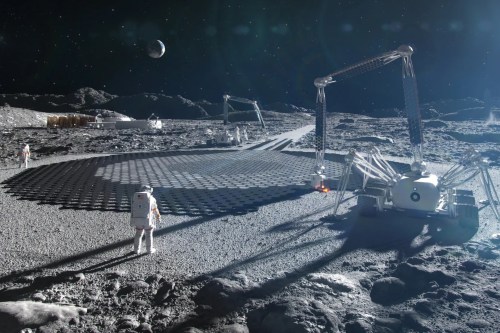
The United States is racing to build a 100‑kilowatt nuclear reactor on the Moon by 2030, driven by a new vision under interim NASA administrator Sean Duffy. Why? To secure a long-term energy source, support lunar bases, and stay one step ahead of China and Russia, who are planning a joint lunar reactor around 2033–35.
How It Would Work
NASA’s Fission Surface Power (FSP) project—backed by the U.S. Department of Energy—has already awarded Phase 1 design contracts to Lockheed Martin, Westinghouse, and IX (Intuitive Machines + X‑Energy) to study compact reactors (~40 kW) that weigh under 6,000 kg and could last at least 10 years.
The design builds on NASA’s Kilopower/KRUSTY experiments, using liquid‑metal cooled, Stirling‑conversion reactors fueled by enriched uranium. These generate continuous power independent of sunlight—critical during the Moon’s 14‑day nights. The new target is a 100 kW reactor, enough energy to support habitats, science labs, and possibly mining operations.
Safety and compactness are key. NASA’s models are sized to fit within rocket payloads and are designed to meet stringent radiation and environmental standards.
Timeline & Urgency
- 2022–2024: Phase 1 conceptual designs funded (~40 kW) complete.
- 2025: Formal directive under Sean Duffy to fast‑track a 100 kW version, with a 60‑day call to industry and top‑down project leadership.
- By 2030: Rocket‑ready delivery of the reactor to the lunar south pole. Deployment ideally before China’s crewed landing in 2030 and ahead of China‑Russia’s 2033–35 reactor effort.
Costs & Challenges
While exact numbers aren’t public, estimates for similar systems suggest:
- Design & development costs: tens to low hundreds of millions per phase.
- Launch & delivery: NASA estimates up to $1 million per kilogram to send mass to the Moon—so a 6,000‑kg reactor could cost on the order of $6 billion in transport alone.
Other hurdles include complex nuclear safety and licensing approvals, engineering to survive lunar launch and operation, and keeping within a tight five‑year timeline. Recent budget cuts to NASA’s science programs also make resourcing more contentious.
Benefits & Strategic Edge
Continuous, Reliable Power
No need to rely on solar panels or batteries during the Moon’s long nights. A reactor can run 24/7, powering habitats, labs, robotics—and potentially producing fuel from lunar ice.
Territorial Influence
Under the Artemis Accords, a nuclear reactor would require exclusion zones—effectively staking a protective perimeter around the site. The U.S. could claim priority access to prime real estate near lunar ice deposits.
Deep‑Space Pathfinder
A successful reactor would open doors—not just for Moon bases but for Mars and asteroid missions, where continuous energy is vital and solar is unreliable. NASA intends to design the system so it can be adapted for Mars without major redesign.
Economic & Tech Leadership
By partnering with private firms, the U.S. hopes to spur commercial space tech, reignite nuclear innovation, and cement leadership in the next chapter of space exploration.
Summary
| Topic | Key Points |
|---|---|
| What | 100 kW nuclear reactor on the Moon |
| Why | To power long‑duration lunar presence and secure strategic advantage over China/Russia |
| How | Fission Surface Power system based on Kilopower tech, private‑sector designs |
| When | Industry proposals in mid‑2025, deployment by 2030 |
| Cost | Possibly billions (design + launch), tough engineering and regulatory hurdles |
| Benefits | Reliable energy, territorial priority, deep‑space readiness, commercial tech boost |
This ambitious plan isn’t just about electricity. It’s about power—in every sense: energy, exploration, and geopolitical leadership. If the U.S. can land a reactor by 2030, it could set the stage for a new era in lunar and space dominance—long before China or Russia’s moon station ambitions come online.