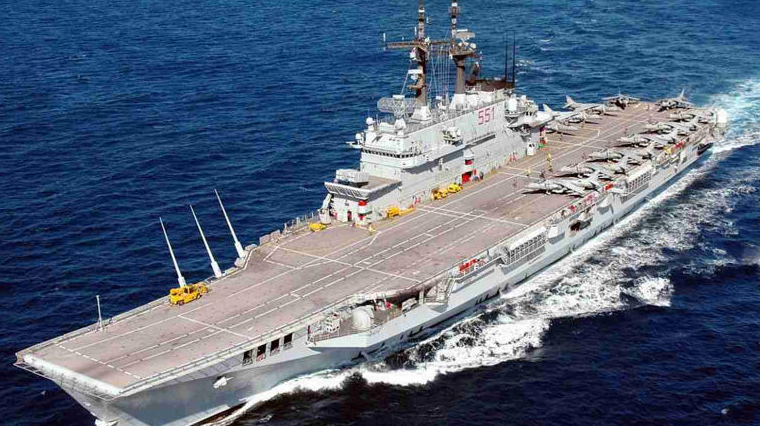
Indonesia has officially approved the purchase of the retired Italian aircraft carrier Giuseppe Garibaldi, a move that marks a major step in strengthening its maritime presence and embracing unmanned aerial systems. Decommissioned by the Italian Navy after nearly 40 years of service, the Garibaldi will receive upgrades to support both rotary-wing aircraft and UAVs, expanding Indonesia’s capabilities in surveillance, reconnaissance, humanitarian aid, and naval aviation.
Key Facts & Figures
- Cost & Funding
The Indonesian government has authorised up to USD 450 million in external loans to pay for the carrier and necessary equipment. In the same funding package, allocations have also been made for new transport helicopters (about USD 250 million) and utility helicopters (USD 300 million). - Ship Specifications & Condition
Giuseppe Garibaldi, built by Fincantieri and commissioned in 1985, is approximately 180.2 meters long, displaces around 14,150 tons fully loaded, and can reach speeds exceeding 30 knots. It has endurance for about 7,000 nautical miles at cruising speed. Experts estimate it has 15–20 years of operational life remaining, provided it’s properly refurbished and maintained. - Upgrade & Conversion Plan
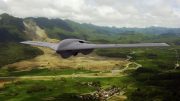
Indonesia plans to convert the carrier to operate not just helicopters but also unmanned aerial vehicles (UAVs). The Bayraktar TB3 (a naval-capable version) is a key candidate. Indonesia has already shown interest in acquiring around 60 TB3 drones, both for shipborne and land-based configurations. Local defence firms showed conceptual models at the Indo Defence Expo & Forum 2025, including a model of the carrier fitted with TB3s. Fincantieri has presented proposals for four work-areas for the conversion/refit to meet the Indonesian Navy’s specific requirements. - Role & Strategic Intent
The acquisition is part of Indonesia’s broader plan, sometimes referred to as the “Minimum Essential Force” or naval modernisation programme. The idea is to build naval autonomy: being able to project power, conduct long-range patrols, bolster deterrence, enhance maritime security, and conduct humanitarian missions. Garibaldi could serve as a mobile aviation hub, especially important in the vast Indonesian archipelago. It also strengthens Indonesia’s partnerships with foreign defence firms (notably from Italy and Türkiye) and promotes local industry involvement in UAV production and ship-refitting.
Challenges & What to Watch For
- Refit – Time & Cost
Though committed, Indonesia has not yet disclosed full costs or schedule for refitting the ship. Upgrades needed include reinforcing the flight deck, installing UAV launch/take-off/landing infrastructure, command and control systems, potentially new radar and electronic warfare capabilities, and a full maintenance overhaul. - Operational & Logistical Readiness
Operating an aircraft carrier demands a huge support ecosystem: trained crew, pilots, UAV operators, maintenance teams, supply chains for parts, fuel, and spare systems. Integrating shipborne UAVs like TB3, which require short takeoff capabilities, will also need technical adjustments. - Financial Sustainability
Not only must Indonesia acquire and refit the ship, but keeping it operational (crewing, maintenance, fuel, upgrades) over its life span will be a long-term expense. Some neighbouring countries that experimented with carrier programs have seen budget overruns or under-utilisation when maintenance and operating costs rose. - Strategic Balance & Risk
With carriers come political and strategic visibility. Indonesia’s neighbors and regional powers will be watching closely. Having the platform might deter threats but also raise tensions. Operational risks such as rough seas, UAV integration, and safety concerns will need careful management.
What This Means Regionally
- If fully operational, Indonesia may become the first Southeast Asian country to operate a true fixed-deck carrier supporting UAV operations, significantly raising its naval status in the Indo-Pacific region.
- The inclusion of the Bayraktar TB3 underlines the rising role of unmanned aerial combat and surveillance systems in naval doctrine. These drones extend reach, allow more persistent surveillance, and reduce risk to human pilots.
- Indonesia’s acquisition fits into larger regional trends: maritime claim disputes, safeguarding trade routes, enhancing ability to respond to natural disasters, search & rescue, and projecting soft-power (e.g. aid, evacuation) across islands.
Bottom Line
Indonesia’s decision to purchase Giuseppe Garibaldi is bold, ambitious, and carries both opportunity and risk. If Indonesian planners can manage the refit efficiently, build up the training, technical, and logistic systems, and keep operating costs under control, this could reshape its naval posture significantly. Whether Garibaldi becomes a symbol or a working, high-capacity asset will depend on the follow-through over the coming years.