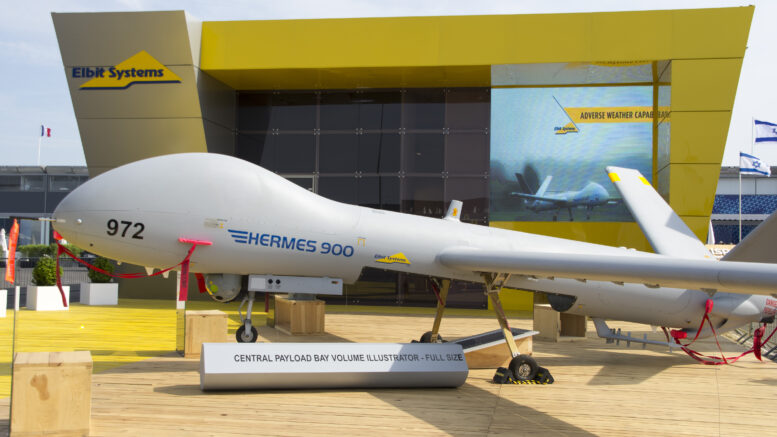
Elbit Systems has landed a $120 million contract to deliver its Hermes 900 unmanned aerial system (UAS) to an undisclosed international customer. The deal highlights the continued global demand for advanced drones capable of operating over land and sea, particularly in the fields of border protection, maritime surveillance, and intelligence gathering.
What is the Hermes 900?
The Hermes 900 is Elbit Systems’ largest and most advanced drone in the Hermes family. Classified as a MALE (Medium Altitude Long Endurance) platform, it can fly at altitudes of over 30,000 feet and stay airborne for more than 30 hours at a time.
Key features include:
- Multi-mission design: equally effective in land and maritime surveillance
- Advanced sensors: electro-optical payloads, synthetic aperture radar (SAR), and maritime patrol radars
- Persistent ISTAR: Intelligence, Surveillance, Target Acquisition, and Reconnaissance over large areas
- Open architecture: allows easy integration of custom payloads such as communications relays, electronic warfare systems, and even precision munitions
For maritime operations, the Hermes 900 can be outfitted with sensors to track ships, detect illegal fishing, secure offshore energy infrastructure, and support search-and-rescue missions.
A proven export success
Since its first order in 2011 by the Chilean Air Force, the Hermes 900 has become one of the world’s most widely adopted drones in its class. Today, more than 20 countries operate the system, including Switzerland, Brazil, Mexico, the Philippines, Israel, and Greece. Several NATO members and Asian-Pacific countries have also integrated the Hermes 900 into their defense networks, often customizing it for unique mission needs.
The platform has already seen real-world operational use:
- Israel deployed the Hermes 900 during combat operations in Gaza.
- Switzerland uses it for border surveillance and disaster response.
- Brazil has operated it for both military and homeland security missions, including major international events.
Why this contract matters
While Elbit has not disclosed the customer, the value and mission profile suggest the buyer is focused on long-range maritime patrols — a growing priority as nations expand their efforts to secure exclusive economic zones (EEZs), monitor illegal trafficking, and protect shipping routes.
The sale underscores a global trend: as threats in the air and sea domains grow more complex, many countries are investing in high-endurance drones that can cover vast areas cheaper and safer than manned aircraft.
Elbit Systems’ global footprint
Elbit Systems has become a leading name in unmanned technology, competing with U.S. and Turkish drone manufacturers in both defense and homeland security markets. Its UAS portfolio, led by the Hermes 900, positions it as a key supplier for nations seeking strategic surveillance capability without relying on U.S.-restricted platforms like the MQ-9 Reaper.
Bottom line
The new $120 million Hermes 900 deal shows that Elbit’s drones are not just a niche product, but a cornerstone of modern surveillance strategy worldwide. With its combination of endurance, flexibility, and multi-domain capability, the Hermes 900 continues to cement its place as one of the most successful export drones of the last decade.