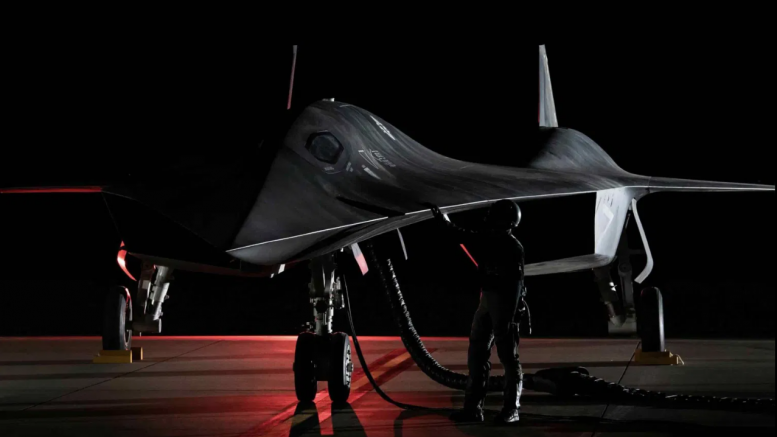
The SR-72 “Darkstar” has captured the public imagination with its sleek, futuristic design and whispered promise of a hypersonic spy plane that could cross continents in minutes. It has been the subject of speculation, fan theories, and even cinematic nods—most notably in Top Gun: Maverick, where a plane resembling the SR-72 makes a dramatic appearance. But is this aircraft real? Could it exist? Or is it all just a masterful blend of military secrecy and Hollywood storytelling?
The Origins of the SR-72
The concept of the SR-72 began to circulate around 2013 when Aviation Week broke a story about Lockheed Martin’s Skunk Works—famed creators of the legendary SR-71 Blackbird—working on a successor. The proposed SR-72 was said to be capable of flying at Mach 6 (over 4,600 mph), using advanced turbine-based combined cycle (TBCC) engines. These would allow the aircraft to transition from conventional jet propulsion to scramjet propulsion as it approached hypersonic speeds.
Lockheed Martin never officially confirmed the existence of a fully operational SR-72, but did acknowledge development work on hypersonic technologies and conceptual studies. They suggested the aircraft could become a reality by the early 2030s, which left open the tantalizing question: how much of it is already in the skies?
Hollywood Meets Hypersonic
In Top Gun: Maverick, the “Darkstar” appears in the film’s opening sequence. The aircraft shown is clearly inspired by Lockheed Martin’s hypersonic designs, and it wasn’t just artistic license. The production team reportedly worked directly with Skunk Works engineers to design the plane featured in the film, lending it a level of realism far beyond standard movie props.
This collaboration has fueled speculation that the SR-72, or at least a demonstrator version of it, might already exist—hidden behind layers of classification and military secrecy. Lockheed Martin even tweeted cryptically about the aircraft after the movie’s release, sparking even more online chatter and theorizing.
What’s Actually Known
The U.S. military and defense contractors have long been interested in hypersonic technology, and significant investments have gone into developing air-breathing engines capable of Mach 5+ speeds. There have been real-world test flights of hypersonic vehicles, like the X-43 and X-51 programs, which demonstrate that the underlying science is sound. Additionally, DARPA and NASA continue to fund hypersonic research, suggesting the goal is more than just fantasy.
Still, no confirmed sightings or declassified documents prove that the SR-72 has flown. Some analysts believe a test article may have taken to the skies under classified conditions, while others argue that the immense technical and budgetary challenges make it unlikely to have progressed beyond early-stage prototyping.
Could It Be Real?
Technologically, a hypersonic reconnaissance and strike aircraft is within the realm of possibility, especially for a country with the resources and aerospace expertise of the United States. The bigger question is whether it’s already operational or still in development.
If it is real, it would likely be one of the most secretive projects in U.S. military history—concealed with the same rigor that shrouded the original SR-71 and F-117 Nighthawk stealth fighter for years before their existence was officially acknowledged.
Conclusion: The Truth Behind the Smoke
So is the SR-72 Darkstar real? The answer lies somewhere between fact and fiction. The concept is real. The technology is being pursued. And the aircraft in Top Gun: Maverick has roots in genuine engineering work. But whether a working prototype is already flying remains officially unconfirmed.
What’s certain is that the myth of the SR-72 is as powerful as its supposed speed. It serves as a fascinating case study in how military ambition, technological possibility, and popular culture intersect—blurring the line between what is and what could be.


