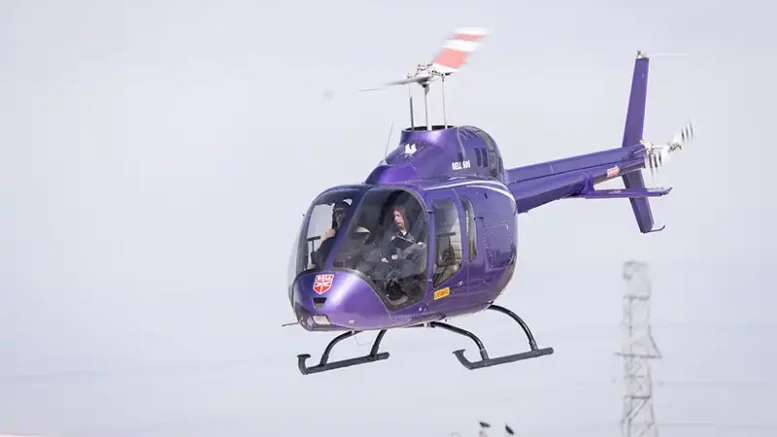
Aviation News – Max Lunov and Nazar Doroshkevych have successfully completed a grueling 10,000-kilometer transatlantic crossing in a light Bell 505 helicopter, marking a significant milestone for regional aviation endurance. The two-man crew navigated through ten countries over 55 flight hours, proving the capabilities of the aircraft under demanding conditions.
The mission began at the Bell Textron Canada Commercial Centre of Excellence in Mirabel and concluded in mainland Europe after two weeks of intensive flying. This journey represents the second successful transatlantic crossing for Max Lunov, owner of the Airborne Group, who previously completed a similar feat in 2021 using a Bell 407GXi. However, this most recent expedition pushed the boundaries of light helicopter operations further than his previous endeavors.
Accompanying Lunov was crew member and drone operator Nazar Doroshkevych, who helped document and manage the logistics of the transatlantic mission. The selection of the Bell 505 for this trip highlights the growing confidence in light single-engine turbines for long-haul ferry flights. By successfully crossing the Atlantic in a newly acquired airframe, the team demonstrated the reliability of the platform for international delivery and utility.
Technically, the flight was a massive undertaking as it was conducted entirely under Visual Flight Rules (VFR). Unlike Lunov’s previous 2021 mission, which utilized Instrument Flight Rules (IFR) and autopilot systems, this journey required manual piloting for the entire duration. Navigating the North Atlantic without autopilot assistance demanded constant manual input and extreme situational awareness, testing the crew’s endurance and the aircraft’s handling across diverse maritime climates.
“This flight demanded absolute precision in planning and execution,” said Max Lunov, pilot and founder of Airborne Group. “Flying VFR across the Atlantic in a light helicopter without autopilot is not just about endurance, it’s about trust in your aircraft, your crew, and your own capabilities.”
This achievement signals a new era for light helicopter versatility, showcasing that modern single-engine aircraft can handle extreme global transit. As operators look for more cost-effective ways to ferry aircraft across continents, the success of this manual VFR flight will likely serve as a case study in pilot skill and airframe durability.
The successful arrival of the Bell 505 in Europe underscores the global reach of the Airborne Group and the technical maturity of the Bell 505 platform. By overcoming the lack of automated flight aids over one of the world’s most unforgiving routes, Lunov and Doroshkevych have set a high bar for civilian helicopter expeditions. The journey reinforces the idea that with rigorous preparation, even the most challenging international corridors are accessible to light turbine aircraft.