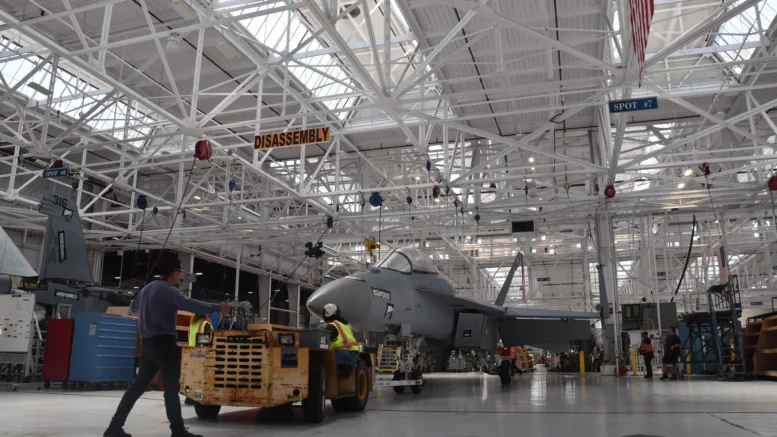
Aviation News – The Fleet Readiness Center Southwest (FRCSW) has successfully completed its first fully organic F/A-18 Super Hornet Block III modification, marking a major shift in naval maintenance capabilities. This milestone signifies that U.S. military artisans and engineers can now execute the military’s most advanced fighter jet upgrades entirely in-house, significantly boosting naval aviation readiness.
This historic achievement at FRCSW represents the culmination of years of deliberate planning and partnership with industry leaders. By transitioning these complex modifications to a military-led workforce, the Navy reduces its reliance on external contractors for deep-level modernization. The project was executed by a specialized team of engineers and technicians who integrated the most advanced technology currently available to the Super Hornet fleet.
The modernization effort was managed through the Service Life Modification (SLM) program, which is divided into three critical phases. The first phase focused on structural extensions to keep the airframes flying longer, while the subsequent phases introduced the sophisticated digital backbone required for modern warfare. This successful in-house execution ensures that the U.S. Navy maintains a sustainable and sovereign capability to upgrade its front-line strike fighters.
Technically, the Block III modification transforms the aircraft by expanding its structural flight life from 6,000 to 10,000 flight hours. Beyond durability, the upgrade installs the Advanced Cockpit System (ACS), featuring a large-area touchscreen display and enhanced networking capabilities. These systems allow the jet to act as a data hub in the sky, improving communication and sensor integration across the entire carrier strike group.
“This achievement represents more than technical success; it is the culmination of deliberate planning and the relentless professionalism of our workforce,” noted officials from FRCSW regarding the program’s completion.
As the Navy moves toward a more digitalized battlespace, this organic capability will be essential for keeping the Super Hornet relevant against emerging threats. Fleet commanders now have a proven domestic pipeline to ensure aircraft remain modernized and mission-ready for decades to come.
Modification (SLM) effort for the Super Hornet fleet. FRCSW and its partners approached this modernization in three phases:
- Structural Service Life Extension – Expanding aircraft life from 6,000 to 10,000 flight hours.
- Block III upgrades to deliver network and mission enhancements.
- Block III Advanced Cockpit System (ACS) and comprehensive avionics modernization.
This phased approach allowed FRCSW artisans and engineers to refine processes, sequence work efficiently, and reduce cost and turnaround time (TAT).
The Block III effort is embedded within the broader SLM program pioneered by FRCSW and Boeing.
The Block III configuration includes significant upgrades including:
- Advanced Cockpit System (ACS) installation
- A new large-area cockpit display
- Comprehensive avionics suite upgrades
- Enhanced aircraft networking capability
- Electrical system modernization to support upgraded systems
Photo USN