AviationNews – Airbus Helicopters has released an operational assessment detailing how its H225 Super Puma fleet tackled severe wildfires across southern Europe, delivering high-volume aerial suppression over more than 640,000 burned hectares. The milestone review underscores the heavy twin-engine helicopter’s expanding footprint in international aerial firefighting, serving as a rapid-response asset during intense seasonal blazes in France and Spain.
The official assessment outlines deployments during a grueling summer wildfire period where over 295,000 hectares burned in Spain and 115,000 hectares burned in France. Specialised commercial operators, including Airtelis and SAF in France, mobilised fleets of H225 and H215 Super Pumas under civil protection contracts to contain fast-moving fronts. The manufacturer launched a dedicated firefighting user group alongside the report, gathering global operators to coordinate technical requirements and tailor fleet configurations for escalating climate extremes.
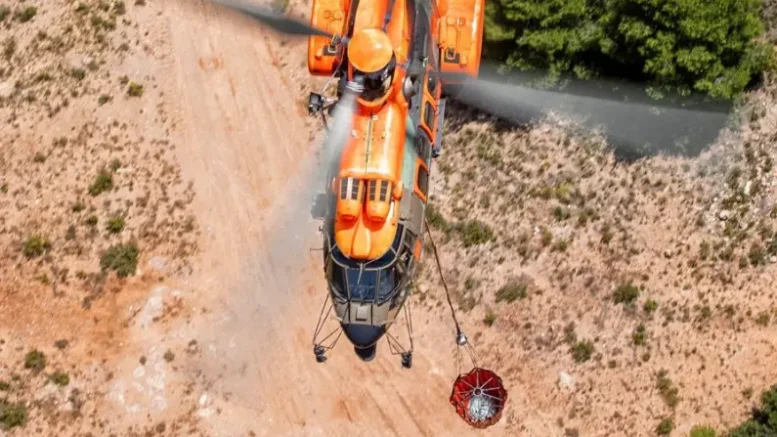
Equipped with flexible belly tanks or suspended buckets holding over 4,000 litres, the Super Puma delivered up to 50,000 litres of water per hour per unit when operating near local water points. The aircraft pairs heavy payload drops with eight-minute scramble times and high-temperature alpine performance, allowing pilots to penetrate narrow canyons and urban fringes. Unlike fixed-wing water bombers that require wide water bodies, the helicopter can refill from small reservoirs or portable tanks and remains certified for night operations and ground-crew troop transport.
“We need to convince governmental agencies that efficient firefighting requires a complete operational ecosystem,” said Régis Macia, head of Super Puma operational marketing at Airbus Helicopters. “The H225 combines substantial water capacity with the civil certification required to carry firefighters directly to the fireline, providing a versatile multi-mission platform where heavy-lift capabilities matter most.”
Looking forward, Airbus Helicopters plans to deepen development with firefighting agencies and European civil protection mechanisms such as rescEU, integrating automated avionics and high-volume delivery systems. As climate pressures lengthen the Mediterranean fire calendar, government agencies are increasingly urged to shift from short-term seasonal leases to permanent multi-role fleets capable of year-round disaster relief.
The Super Puma’s operational review confirms its standing as an indispensable heavy-lift resource against large-scale wildfires. Combining precision water drops with troop insertion and nighttime flight capability, the platform offers emergency services a resilient aerial vanguard for future fire seasons.