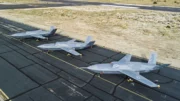
AviationNews – The U.S. Air Force has released an updated strategic framework outlining its path to future air superiority. The revised plan focuses heavily on integrating crewed sixth-generation stealth fighters with autonomous Collaborative Combat Aircraft (CCA) to preserve tactical advantages while curbing skyrocketing procurement costs.
The policy refinement marks a significant pivot in the Next Generation Air Dominance (NGAD) family of systems architecture. Facing escalating budget pressures and evolving electromagnetic and aerial threats, military leadership paused the primary fighter platform development to reassess system requirements. Under the updated strategy, the U.S. Air Force intends to shift non-essential sensors, electronic warfare equipment, and kinetic weapons loads from expensive crewed airframes onto uncrewed autonomous wingmen. This approach maintains a multi-tier force structure that balances advanced capabilities with affordable combat mass.
Operationally, Collaborative Combat Aircraft act as robotic extensions of piloted aircraft, flying ahead of formations to conduct electronic jamming, ISR (intelligence, surveillance, and reconnaissance), or missile strikes in high-risk contested airspace. Built on open-system software architecture, these uncrewed aircraft allow rapid hardware updates and AI autonomy enhancements from multiple defense vendors. By offloading high-risk operational tasks to autonomous platforms, air commanders can expand their sensor network coverage and strike volume while keeping human pilots out of lethal air defense threat zones.
“Once you start integrating Collaborative Combat Aircraft and transferring some mission equipment and capability functions to the CCAs, then you can talk about a different operational concept,” stated former Air Force Secretary Frank Kendall regarding the force structure shift. “One way to think of CCA is as remotely controlled versions of the targeting pods, electronic warfare pods, or weapons now carried under the wings of our crewed aircraft.”
Looking ahead, the updated doctrine establishes a clear roadmap for combining crewed jet technology with mass-produced autonomous wingmen. Air force command teams will continue flight-testing early prototype drones, refining human-machine teaming protocols, and preparing operational squadrons for full integration over the coming decade.
The strategic pivot ensures that U.S. Air Force air superiority capabilities remain flexible and financially sustainable in high-threat environments. By prioritizing uncrewed autonomous wingmen alongside core fighter platforms, defense planners pave the way for a more scalable, network-centric aerial warfare architecture.