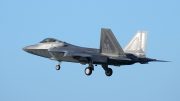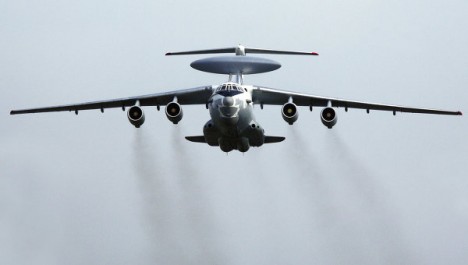
AviationNews – Faced with an increasingly overwhelmed ground-based air defense network, the Russian Aerospace Forces have resorted to deploying their high-value A-50U early warning aircraft and fifth-generation Su-57 fighters as dedicated “drone hunters.” This tactical shift highlights the growing threat of deep-strike Ukrainian kamikaze drones successfully penetrating thousands of kilometers into Russian airspace.
Recent reports confirm that Russia is combining these advanced aerial assets to detect and intercept long-range Ukrainian drones, as seen during a massive attack on an oil refinery in Omsk, nearly 2,700 kilometers from the Ukrainian border. With traditional surface-to-air missile systems struggling to track low-flying targets over vast territories, the military has paired the long-range radar surveillance of its few remaining A-50U Airborne Early Warning and Control (AEW&C) planes with the interception capabilities of the Su-57. Despite this formidable airborne defense, footage from early July 2026 showed that multiple drones still successfully struck the Gazpromneft-ONPZ refinery.
The A-50U acts as a flying command center, capable of identifying ultra-low-flying drones up to 200 miles away that remain hidden from ground-based radars due to the Earth’s curvature. Once detected, the Su-57 stealth fighters are scrambled to intercept the targets. To fulfill this specific role, the Su-57s have been equipped with a 101KS-N electro-optical targeting pod and external R-73 or R-74 short-range air-to-air missiles. Although mounting weapons externally compromises the aircraft’s stealth profile, it allows the jet to engage small, maneuverable drones that are difficult to target with standard internal armaments.

“This is the first instance I have seen of both platforms present in the same location. To fly this low highlights how difficult these drones must be to detect,” noted Michael Bohnert, an analyst with the RAND Corporation, emphasizing the unprecedented nature of this joint deployment.
As Ukraine continues to refine its long-range drone capabilities, Russia will likely be forced to overextend its limited fleet of advanced aircraft to protect critical infrastructure deep within its borders. However, continuously flying high-value assets like the A-50U and Su-57 exposes them to significant maintenance strain and potential attrition. Military planners globally will closely study this improvisation, as it underscores the urgent need for cost-effective, dedicated anti-drone architectures rather than relying on multi-million-dollar fighter jets to intercept cheap, autonomous threats.
The forced adaptation of Russia’s A-50U and Su-57 fleets into an anti-drone role exposes critical vulnerabilities in conventional ground-based air defense networks against modern, low-flying unmanned aerial vehicles. As the aerial conflict evolves, both sides must rapidly innovate their defensive strategies, setting new precedents for how advanced fighter aircraft integrate into asymmetric warfare.