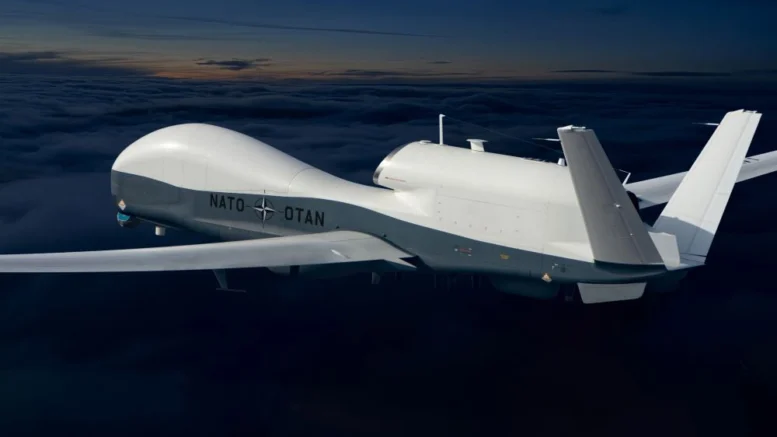
Aviation News – American defense contractor Northrop Grumman and European aerospace giant Airbus Defence and Space have signed a key agreement to bring the advanced MQ-4C Triton uncrewed aircraft system to NATO operations. This strategic alliance establishes a transatlantic framework to integrate these state-of-the-art surveillance drones, strengthening NATO’s collective intelligence and maritime monitoring capabilities across critical allied territories.
The Memorandum of Understanding (MOU) was finalized during the NATO Summit Defence Industry Forum on July 7, 2026, in Ankara, Turkey, marking a significant milestone for allied security. This industrial partnership directly supports a recently announced Letter of Intent (LOI) by Denmark, Finland, Germany, and Norway to expand the NATO Intelligence, Surveillance and Reconnaissance (ISR) Force with up to five Triton platforms. While Northrop Grumman acts as the prime manufacturer for the high-altitude aircraft, Airbus will spearhead the development of the vital ground segment and data management infrastructure.
To accelerate the integration process, both defense giants are engaging a robust consortium of European defense specialists to form a full-spectrum service proposal. Key international partners include Kongsberg Defence & Aerospace of Norway, Insta Advance of Finland, Terma of Denmark, and Exence of Poland. This collaborative approach builds upon more than a decade of shared expertise from operating NATO’s current RQ-4D Phoenix fleet, ensuring seamless synergy and maximizing cost efficiency across the alliance.
Technically, the MQ-4C Triton is a high-altitude, long-endurance (HALE) uncrewed platform engineered specifically for persistent maritime surveillance. Operating at altitudes exceeding 15 kilometers (50,000 feet) for over 24 hours, the autonomous aircraft uses specialized high-resolution sensors and intelligent data-sharing networks to detect early threats. This provides commanders with unprecedented situational awareness over vast geographical zones, protecting critical sea lanes of communication from the Mediterranean all the way to the harsh environments of the High North and the Arctic.
“Our collaboration with Alliance members on the expansion of NATO’s ISR Force will bring the most advanced ISR capabilities to the Alliance, bolstering its regional security and enhancing Europe’s defense industrial base,” said Jane Bishop, vice president and general manager of Global Surveillance at Northrop Grumman.
Looking forward, this industrial cooperation signals a deeper integration of European and American military capabilities, establishing a modern template for cooperative defense procurement. Allies must now fast-track the operational rollout of these platforms to counter rapidly evolving geopolitical challenges on the northern flank. Defense planners and member nations are encouraged to fully leverage this shared aerospace framework, utilizing the pooled infrastructure to maximize intelligence output while keeping individual operational costs low.
The landmark agreement between Northrop Grumman and Airbus marks a transformative moment for transatlantic defense integration. By bringing the MQ-4C Triton into NATO’s collective fold, the alliance guarantees high-altitude, persistent surveillance over vital global waterways. As these autonomous eyes in the sky prepare to deploy, NATO takes a massive step toward securing its territorial borders for the future.