Aviation News – NASA has shipped the core stage of its SLS rocket to Florida, marking a major milestone toward the Artemis III mission planned for 2027 and the first crewed lunar landing in decades.
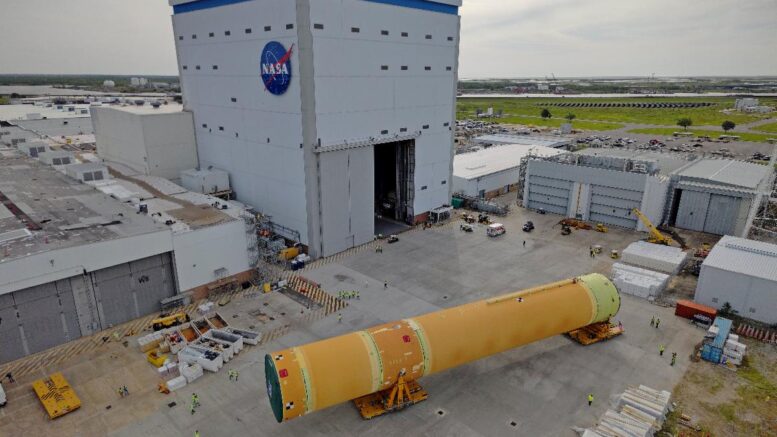
The massive core stage departed the Michoud Assembly Facility in New Orleans on Monday, heading to the Kennedy Space Center after the recent success of the Artemis II lunar test flight. The shipment represents a critical step in NASA’s Artemis program, which aims to return humans to the Moon and establish a foundation for future deep space exploration. Engineers used specialized transporters to move the upper portion of the rocket stage—housing key systems including liquid hydrogen and oxygen tanks—onto the Pegasus barge for delivery. Once in Florida, teams will complete final outfitting and prepare for full vehicle assembly.
The SLS rocket serves as the backbone of the Artemis missions, designed to carry astronauts and heavy payloads beyond Earth orbit. Its core stage provides the primary propulsion during launch, generating the thrust needed to send the spacecraft toward the Moon. The upcoming integration process will involve stacking the rocket components and conducting system checks under NASA’s Exploration Ground Systems Program, ensuring readiness for the demanding conditions of deep-space travel.
“Seeing this SLS rocket hardware roll out is a powerful reminder of our progress toward returning humans to the lunar surface,” said Lori Glaze, acting associate administrator for NASA’s Exploration Systems Development Mission Directorate. “This is the backbone of Artemis III. As it heads to Florida for final integration, we are one step closer to testing the critical capabilities needed to land Americans on the Moon, and ultimately paving the way for our first crewed missions to Mars.”
Looking ahead, the Artemis III mission is expected to mark the first time astronauts set foot on the Moon since the Apollo era, while also demonstrating new technologies for sustained lunar exploration. The mission will play a crucial role in validating systems needed for long-term presence on the Moon and eventual human missions to Mars.