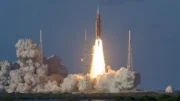
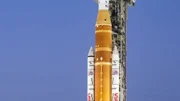
AviationNews – NASA has officially confirmed that the Artemis II mission, the first crewed flight to the Moon in over half a century, is scheduled to launch on March 6, 2026. This historic 10-day mission will carry a crew of four astronauts around the Moon, marking a pivotal step in the agency’s long-term goal of establishing a sustainable human presence on the lunar surface.
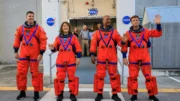
The mission serves as the second flight under the Artemis program and follows the successful uncrewed Artemis I test in 2022. The crew—Commander Reid Wiseman, Pilot Victor Glover, and Mission Specialists Christina Koch and Jeremy Hansen—was selected to validate the performance of the Space Launch System (SLS) rocket and the Orion spacecraft. Development has faced several delays, including recent technical adjustments to the Orion heat shield and life-support systems, but the March 6 date reflects a firm commitment to mission readiness following a rigorous “wet dress rehearsal” at Kennedy Space Center.
Technically, the mission utilizes a free-return trajectory, a fuel-efficient path where Earth’s gravity naturally pulls the spacecraft home after its lunar flyby. During the flight, the crew will test the European Service Module, which provides essential power and life support, and conduct “proximity operations” to evaluate manual piloting capabilities. A significant technical highlight includes the test of the Optical Communications System (O2O), which aims to transmit high-definition data and video from deep space at rates significantly faster than current radio systems.
“We are going back to the Moon because it is the next step in our journey to Mars,” stated Commander Reid Wiseman during a recent mission briefing. “This mission is about confirming our systems operate as designed with a crew aboard in the actual environment of deep space.”
Successful completion of this lunar flyby will clear the path for Artemis III, the mission intended to land the first woman and person of color on the Moon. By testing these foundational deep-space capabilities now, NASA and its international partners are building the operational experience necessary for eventual human exploration of Mars.
The Artemis II launch represents a new era of international cooperation and technical achievement in space exploration. By sending humans 10,300 km beyond the far side of the Moon, NASA will verify the safety of its deep-space hardware for future generations. This mission is not just a test flight, but a bridge to the next frontier of human discovery.