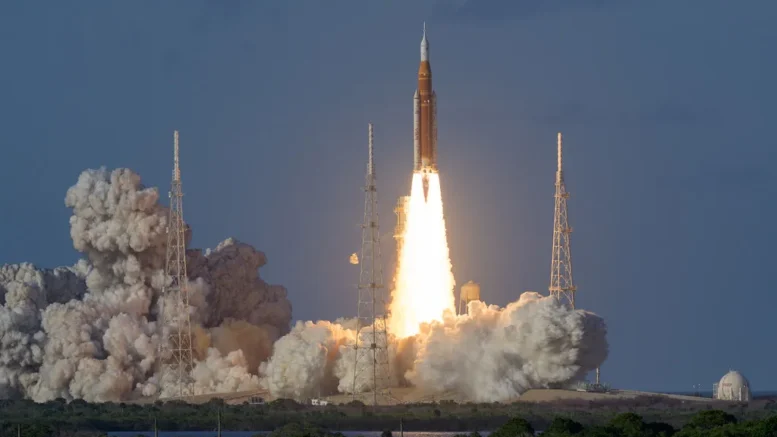
Four astronauts have begun their journey toward the Moon, marking the first crewed lunar mission since 1972 and a major milestone for space exploration.
The mission, known as Artemis II, lifted off overnight from Cape Canaveral in Florida, signaling a renewed push by NASA to return humans to deep space and eventually establish a sustained presence on the Moon.
The Artemis program was first announced as a successor to the Apollo missions, with Artemis II selected as the first crewed flight in the series after years of development and testing. The last time humans traveled toward the Moon was during Apollo 17 in December 1972. Since then, multiple international partners and private contractors have contributed to the program, reflecting a broader global effort to advance human spaceflight capabilities.
The mission uses NASA’s powerful Space Launch System rocket and the Orion spacecraft, designed to carry astronauts farther than any previous human-rated vehicle in decades. The flight will test critical systems needed for future lunar landings, including life support, navigation, and deep-space communication. Its success is essential for enabling sustained lunar operations and preparing for eventual missions to Mars.