AviationNews –
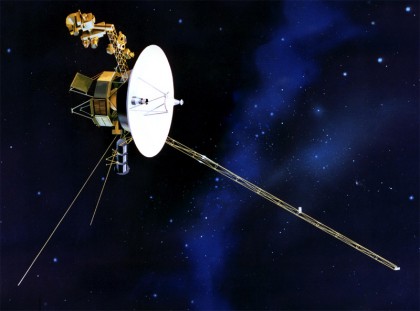
NASA has officially powered down a primary science instrument aboard Voyager 1 to conserve the spacecraft’s dwindling energy reserves and extend its record-breaking journey through interstellar space. After nearly 50 years of continuous operation, the Low Energy Charged Particle (LECP) detector was deactivated to ensure the probe remains functional as it travels further from Earth than any other human-made object.
The LECP has been a vital component of the mission since its launch in 1977, providing critical data on ions, electrons, and cosmic rays. This decision follows a similar power-saving measure taken on Voyager 2 last year. Voyager 1, which transitioned into the space between stars in 2012, is currently cruising more than 25 billion kilometers away from our planet. Managing a legacy spacecraft at such distances presents unique challenges, as commands traveling at the speed of light take over 23 hours to reach the probe’s receivers.
By disabling the heater and the instrument itself, NASA engineers hope to manage the probe’s finiteness of fuel more effectively. While seven other instruments were silenced in previous years to prioritize survival, only two active sensors now remain. However, the mission team is currently testing a sophisticated reconfiguration plan that involves cycling power between different components, which may eventually allow the LECP to be briefly reactivated for future snapshots of the deep cosmos.
“Every watt of power is precious as we push the boundaries of exploration; this step is essential to keeping our most distant scout talking back to Earth for as long as possible,” noted a representative regarding the mission’s longevity.
Looking ahead, the Voyager 1 mission will continue until its power supply is completely exhausted. Even after the electronics go dark, the probe will maintain its trajectory through the galaxy at a speed of approximately 17 kilometers per second. In roughly 40,000 years, the silent messenger is expected to pass within the vicinity of the star Gliese 445, carrying its “Golden Record” as a permanent archive of humanity.
NASA’s strategic power management reflects a commitment to squeezing every possible discovery out of this aging pioneer. By prioritizing core communication systems over specific sensors, the agency ensures that Voyager 1 remains a functional interstellar ambassador for years to come.