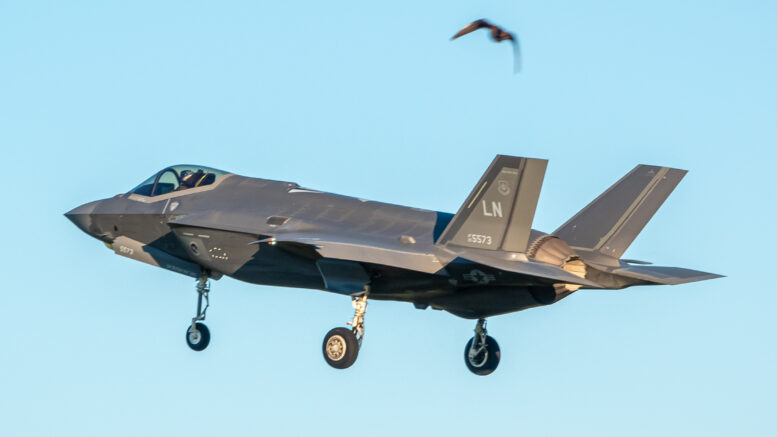
Aviation News – A U.S. Air Force F-35A Lightning II made an emergency landing at a regional base on Thursday after reportedly being struck by Iranian fire during a combat mission. The incident marks the first time a manned American aircraft has been hit by hostile fire since the current conflict began on February 28.
The Pentagon and U.S. Central Command (CENTCOM) confirmed that the fifth-generation fighter was forced to divert from its mission over Iran to an undisclosed U.S. airbase in the Middle East. While official details remain scarce, reports and unconfirmed video footage suggest the aircraft was targeted by an advanced Iranian air defense system. The incident follows weeks of high-intensity operations under Operation Epic Fury, where both U.S. and Israeli F-35s have been utilized to penetrate sophisticated airspace.
The selection of the F-35A for these missions highlights its role as a cornerstone of modern air power, designed to operate in “contested” environments. However, the Islamic Revolutionary Guard Corps (IRGC) has claimed responsibility for the strike, asserting that their localized defense upgrades are now capable of challenging stealth technology. The March 19 incident is currently under a formal investigation to determine the exact nature of the weapon system used and the extent of the damage to the $100 million airframe.
The F-35A relies on its low-observable (stealth) profile and integrated sensor fusion to avoid detection; however, if the reported strike is verified, it suggests a significant shift in the operational impact of regional threats. Military analysts are examining whether the jet was hit by shrapnel from a surface-to-air missile or targeted during a lower-altitude phase of its mission. Despite the damage, the aircraft’s robust design allowed the pilot to maintain control and perform a successful emergency recovery.
“The aircraft landed safely, and the pilot is in stable condition,” stated Capt. Tim Hawkins, a spokesperson for U.S. Central Command, emphasizing that the safety of the crew remained the immediate priority following the engagement.
The future outlook for the air campaign may now require a shift in tactical approaches to ensure continued air superiority. Military commanders will likely reassess flight corridors and electronic warfare support to counter these emerging threats. For now, all eyes remain on the results of the Pentagon’s investigation to see how this development influences the broader strategy in the Middle East.
The safe recovery of the pilot and the airframe provides a critical opportunity for the U.S. Air Force to analyze the engagement data. As the conflict continues, the resilience of fifth-generation platforms will be tested against increasingly capable adversaries. Future missions will likely incorporate these lessons to maintain the tactical edge in one of the world’s most complex battlespaces.