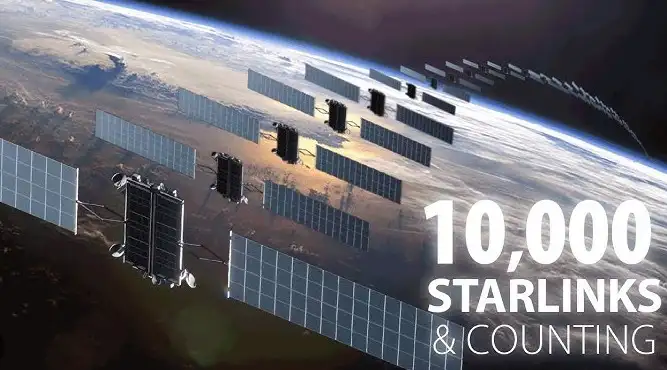
AviationNews – SpaceX has officially surpassed the 10,000-satellite mark for its Starlink constellation following a successful mission from California. This achievement solidifies the company’s dominance in the low Earth orbit sector and marks a massive leap in global internet connectivity.
The milestone was reached on March 17, 2026, after a Falcon 9 rocket deployed 25 Starlink V2 Mini satellites from Vandenberg Space Force Base. This specific launch pushed the total number of active units past the five-figure threshold, a goal that seemed impossible just a few years ago. Since the first experimental batch in 2019, SpaceX has rapidly scaled its production and launch cadence to meet the rising global demand for high-speed, low-latency satellite broadband.
Technically, the V2 Mini satellites are significantly more advanced than their predecessors, featuring more powerful phased-array antennas and the use of E-band for backhaul. These upgrades allow for nearly four times the capacity per satellite compared to earlier versions. By operating in low Earth orbit (LEO) at altitudes around 550 kilometers, the system provides faster response times than traditional geostationary satellites, which orbit much further away.
“Surpassing 10,000 active satellites is more than just a numerical record; it represents our ability to provide reliable communication to the most remote corners of the planet,” a SpaceX representative stated during the post-launch briefing. “We are fundamentally changing how the world stays connected.”
The future of the Starlink project involves further expansion toward a planned constellation of nearly 42,000 satellites. As SpaceX prepares for more frequent Starship launches, the deployment of even larger V2 satellites will likely accelerate, bringing cellular-to-satellite services to standard smartphones worldwide.
With over 10,000 satellites now circling the globe, SpaceX has proven that large-scale satellite mega-constellations are a functional reality. The company continues to lead the private space race, setting a high bar for competitors in the telecommunications and aerospace industries.


