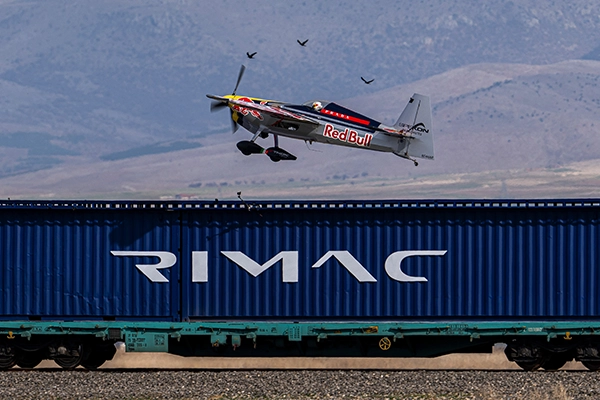
Aviation News – Italian Red Bull athlete Dario Costa has achieved a world-first aviation milestone by successfully landing a race aircraft on a moving cargo train before executing an immediate vertical takeoff. The high-stakes maneuver took place on February 15, 2026, in Afyonkarahisar, Türkiye, marking the first time a fixed-wing aircraft has interacted with a moving railway platform at operational speeds.
The feat involved a specially optimized Zivko Edge 540 aerobatic plane and a cargo train traveling at a constant 120 km/h (65 knots). Costa had a narrow 50-second window to align with the ninth container of the moving train along a 2.5 km stretch of track. The project, which was two years in the making, required the 44-year-old pilot to undergo intense cognitive training at the Red Bull Athlete Performance Centre in Austria to master the “time-movement-anticipation” skills necessary for a blind landing where the target was obscured by the aircraft’s nose.
Technical precision was the defining factor of the mission, as Costa had to reduce his airspeed to a near-stall velocity of 87 km/h (47 knots) to safely touch down on the narrow container. The maneuver was further complicated by wake turbulence and unstable airflow generated by the moving train, which stripped 33 km/h (18 knots) of relative airspeed from the wings. To assist with the final moments of the approach, engineers integrated a laser altimeter system that provided real-time audio cues to the pilot’s headset, ensuring the wheels met the moving target with centimeter-level accuracy.
“Train Landing was one of the most challenging and demanding projects of my career,” said Dario Costa. “The greatest test was learning to land blind on a very small moving runway—relying only on cognitive and flying skills. For the first time, an aircraft successfully interacted with a moving train, bringing together the oldest motorized transportation with the newest.”
This achievement pushes the boundaries of applied aerodynamics and pilot coordination, demonstrating new possibilities for aircraft operations in non-traditional, restricted environments. As aviation technology continues to evolve, the data gathered from this extreme synchronization of speed and physics will likely inform future developments in autonomous flight and precision landing systems.
Photo Red Bull