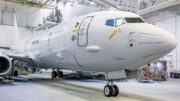
Aviation News – Germany has begun transferring the first aircraft for its PEGASUS airborne surveillance program from the United States to Germany, marking a key step toward operational readiness by 2028. The system is designed to significantly strengthen the Bundeswehr’s long-range intelligence and early warning capabilities.
The PEGASUS (Persistent German Airborne Surveillance System) program is based on the Bombardier Global 6000 business jet, which will be converted into a manned intelligence, surveillance and reconnaissance platform. After arrival in Germany, the aircraft will be fitted with advanced reconnaissance technology, forming a central pillar of the country’s future airborne intelligence architecture.
PEGASUS is intended to enable the Bundeswehr to detect and analyze military radio communications and radar emissions from long distances. By providing persistent airborne coverage, the system will support crisis early warning, situational awareness and threat assessment in potential operational areas, strengthening national and allied defense readiness.
Operationally, the Global 6000 platform offers long range, high endurance and stable flight characteristics, making it well suited for persistent surveillance missions. Combined with modern sensor suites and data processing systems, PEGASUS is expected to deliver timely intelligence while operating at stand-off distances, reducing risk to crews and assets. The program also represents a technological bolt reinforcing Germany’s airborne ISR capabilities.
In addition to Bombardier, Lufthansa Technik and Hensoldt, around 30 other companies are involved in the development and conversion of the aircraft. Delivery to the Bundeswehr is planned from 2027, with initial operational capability expected from 2028. The PEGASUS (Persistent German Airborne Surveillance System) fleet will be based with Tactical Air Force Wing 51 “Immelmann” at Schleswig-Jagel Air Base.
Photo Bombardier
Source Bundeswehr