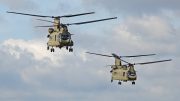
The year 2025 marks the 50th anniversary of the Boeing AH-64 Apache, one of the world’s most iconic and enduring attack helicopters. Since its first flight on 30 September 1975, the Apache has remained at the forefront of battlefield aviation, undergoing continuous modernization while serving with the United States Army and numerous allied air forces worldwide.
Origins (1970s)
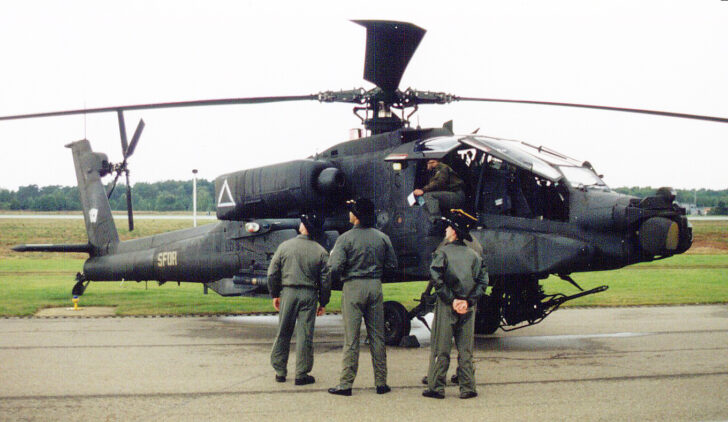
McDonnell Douglas AH-64A Apache 86-8955 2/6 Cavalary U.S. Army
The Apache was born from the Advanced Attack Helicopter (AAH) program, launched by the U.S. Army in 1972 to develop a successor to the AH-1 Cobra. Hughes Helicopters’ prototype, the YAH-64, first flew in 1975, beating Bell’s YAH-63. The design featured tandem seating, a chin-mounted 30 mm chain gun, and stub wings for missiles and rockets—setting the foundation for decades of service.
Cold War Service (1980s–1991)
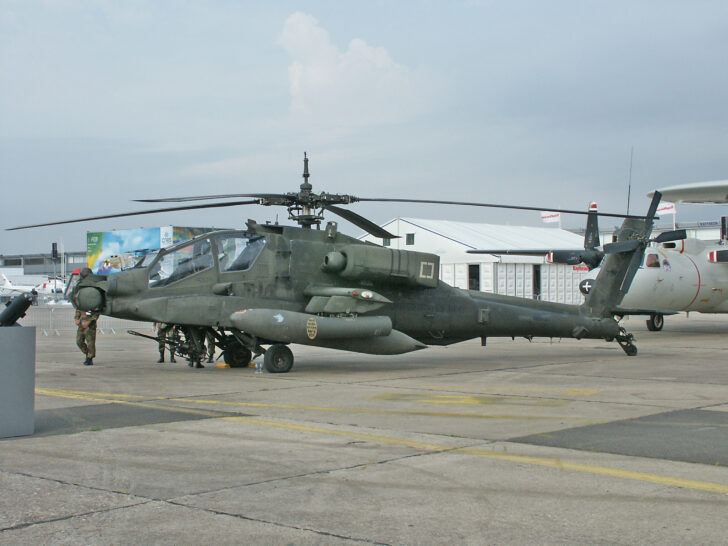
McDonnell Douglas AH-64A Apache 87-0419 U.S. Army
The Apache entered operational service in 1986 as the AH-64A. It was designed to counter massed Soviet armor in Europe, equipped with AGM-114 Hellfire missiles to destroy tanks. By the late 1980s, hundreds had been delivered to the U.S. Army, and the Apache had also begun to attract export interest.
The helicopter saw its first major combat during Operation Just Cause in Panama (1989) and quickly gained international attention during the Gulf War (1991), where Apaches destroyed Iraqi radar installations and armored formations with devastating effectiveness.
Modernization and the Longbow Era (1990s–2000s)
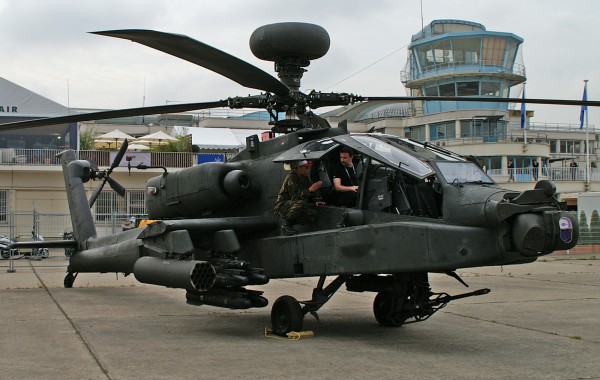
AH-64D Apache Longbow U.S. Army
The end of the Cold War did not end the Apache’s relevance. In the mid-1990s, the U.S. Army introduced the AH-64D Apache Longbow, featuring the distinctive AN/APG-78 radar dome, advanced avionics, and all-weather targeting systems. The Longbow variant became the backbone of U.S. Army aviation and was widely exported.
Apaches played central roles in Kosovo (1999), Afghanistan (2001–2021), and the Iraq War (2003–2011), conducting close air support, anti-armor strikes, and counterinsurgency operations.
The Guardian and the Digital Battlefield (2010s–2020s)
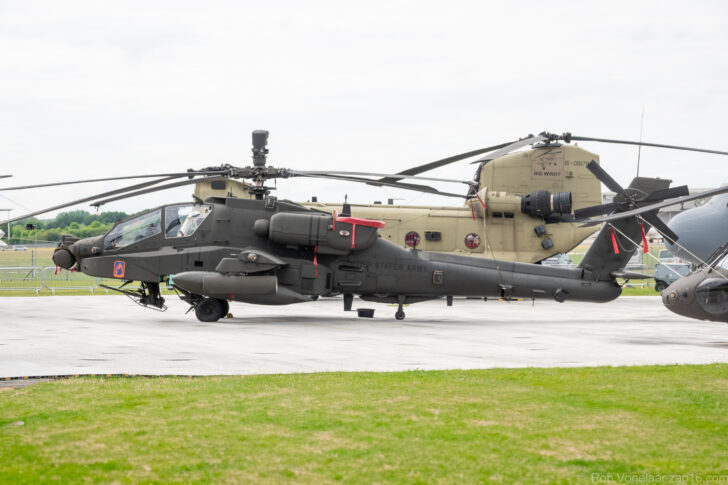
Boeing AH-64E Apache Guardian 22-03486 1-3rd AVN US Army
The latest version, the AH-64E Guardian, entered service in the 2010s. It introduced more powerful engines, improved digital systems, and the ability to control unmanned aerial vehicles (UAVs), integrating the Apache into a network-centric warfare environment.
The AH-64E has been adopted by several U.S. allies, ensuring the Apache remains a global standard in attack helicopter design.
Operators

Westland WAH-64D Longbow Apache AH.1 ZJ172 Army Aviation
As of 2025, major operators include:
-
United States Army
-
British Army (Apache AH Mk1 / AH-64E)
-
Israeli Air Force
-
Royal Netherlands Air Force
-
Indian Air Force
-
Japan Ground Self-Defense Force
-
Egyptian Air Force
- Australian Air Force
- Polish Air Force
- Hellenic Air Force
Over five decades, more than 2,400 Apaches have been built, serving in over a dozen countries. The Apache has become a symbol of American airpower, combining firepower, survivability, and adaptability.
The helicopter has not only survived the Cold War, but also adapted to 21st-century conflicts, from open desert warfare to counterinsurgency and drone-assisted operations.

McDonnell Douglas AH-64D Apache Q-17 301sq Royal Netherlands Air Force in Demo colours
50th Anniversary (2025)
In 2025, the Apache marks 50 years since its maiden flight. Boeing and the U.S. Army have celebrated the milestone by highlighting its combat history, technological evolution, and continued upgrades. The Apache is expected to remain in service into the 2060s, making it one of the longest-serving military aircraft in history.

AgustaWestland Apache AH.2 ZM712 663sq AAC
Photos Rob Vogelaar