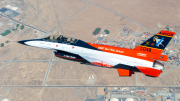
A test program involving the advanced Martin‑Baker US18E ejection seat and the Royal Danish Air Force’s F‑16AM variant (originally upgraded F‑16A Block 10s) underscores a proactive approach to enhancing aircrew safety in export aircraft like the F‑16 Block 70/72.
Selected by Lockheed Martin in November 2020, the US18E is a refined adaptation of the US16E seat used in the F‑35, tailored to the narrower F‑16 cockpit while maintaining critical safety features. Key enhancements include:
-
Expanded pilot accommodation from 103 lbs to 245 lbs, accommodating a broader spectrum of body sizes, making it gender-neutral.
-
Safe ejection capability while using Helmet-Mounted Displays (HMDs), addressing modern cockpit technology needs.
-
A modular design that simplifies maintenance, reducing time for canopy removal and seat replacement.
-
Electronic sequencer supported by a mechanical backup, active arm restraints and passive leg restraints, plus head-and-neck protection derived from an airbag-like system.

Operational Sequence: Martin-Baker US18E Ejection Seat
The US18E builds on the proven US16E design used in the F-35, adapted for the F-16’s narrower cockpit. Here’s how the ejection sequence works:
1. Initiation
-
The pilot pulls the ejection handle (between the legs or above the head).
-
A cartridge-actuated device (CAD) ignites to start the ejection process.
2. Canopy Jettison / Fracture
-
The canopy is jettisoned or fractured using miniature detonation cords.
-
This clears the path for the seat to exit the aircraft safely.
3. Rocket-Assisted Launch
-
A main gun or under-seat rocket motor propels the seat and pilot out of the cockpit vertically at high speed.
4. Stabilization
-
Drogue chutes deploy automatically to stabilize and slow the seat.
-
An electronic sequencer manages altitude, speed, and seat orientation.
-
Active arm and leg restraints prevent flailing and injury during rapid acceleration.
5. Parachute Deployment
-
At a safe altitude and speed, the system separates the pilot from the seat.
-
The main parachute deploys for descent.
6. Survival Pack Activation
-
Upon landing, the integrated survival kit under the seat becomes accessible (may include radio, medical supplies, beacon, etc.).
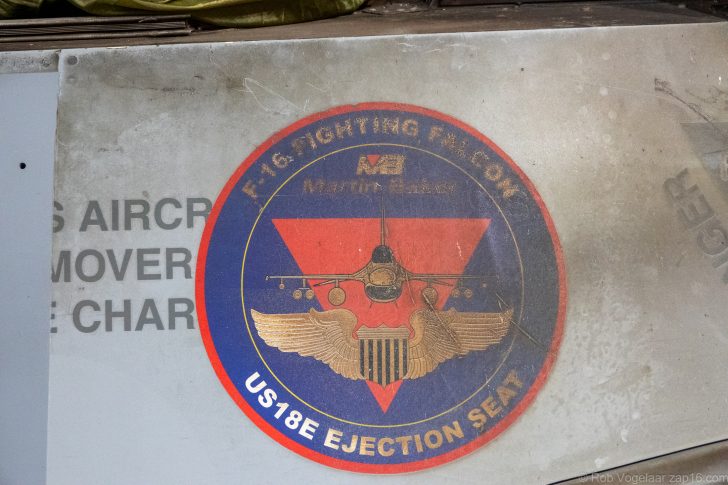
Martin-Baker – forward fuselage F-16AM E-196 Denmark
Comparison with Older F‑16 Ejection Seats (ACES II)
| Feature | US18E (Martin-Baker) | ACES II (Collins Aerospace) |
|---|---|---|
| Weight Accommodation | 103–245 lbs (wider range, gender-neutral) | 140–211 lbs |
| Helmet-Mounted Display Compatibility | Optimized | Limited |
| Restraints | Active arm & passive leg restraints | Passive restraints |
| Neck Protection | Airbag-like head & neck protection | None |
| Sequencing | Electronic + mechanical backup | Mechanical only |
| Maintenance | Modular design, quicker swap-outs | More labor-intensive |
| Pilot Safety | Higher G-tolerance, better spinal protection | Legacy performance |
| Operational Altitude/Speed | Safe ejection at 0–60,000 ft & subsonic/supersonic | Similar but with lower biomechanical protection |
Why It Matters
The US18E is a generational leap in pilot safety, especially relevant as fighter cockpits adopt heavier helmet systems, greater G-forces, and more diverse pilot populations. Its integration into Denmark’s F‑16AM suggests a trend toward upgrading legacy fleets with F-35-level crew protection.