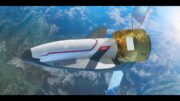
AviationNews.eu – HAP‑alpha (High‑Altitude Platform alpha) is an uncrewed solar-powered aircraft designed by DLR to operate as a technology demonstrator in the lower stratosphere—up to approximately 20 km altitude.
What Is It?
- The aircraft has a bespoke lightweight structure, weighing roughly 138 kg with a 27-meter wingspan, and a wing structure alone of only 36–40 kg.
- Built with advanced carbon-fiber reinforced polymers, the design achieves extraordinarily low surface loadings (sub‑5 kg/m²), enabling sustained high-altitude operations.
- The project is a collaboration of 16–17 DLR institutes, led by the Institute of Flight Systems, with contributions ranging from aeroelasticity and propulsion to ground station operations and sensor development.
Capabilities & Mission Objectives
Stratospheric Endurance
- Powered entirely by solar energy, HAP‑alpha is designed for long-duration station-keeping above commercial air traffic and weather systems, paralleling satellite functions but with recoverable and reusable hardware.
- Extended missions with minimal disruption and flexible redeployment location-wise are core goals.
Payload & Systems
- Designed to carry up to 5 kg of payload including:
- MACS‑HAP: a modular high-resolution optical camera capable of ~15 cm ground resolution from 20 km altitude
- HAPSAR: a lightweight synthetic aperture radar system (~50 × 50 cm resolution, ~250 W power).
- Supports Earth observation, environmental monitoring, disaster response, shipping route reconnaissance, ice surveillance, or communications relay tasks.
Development & Testing Timeline
- The HAP project began in 2018, with expected completion around 2025, covering platform, payload, ground station, and operational procedures.
- In July 2025, HAP‑alpha successfully passed major ground vibration tests (GVT) at DLR’s Cochstedt test centre, crucial for assessing the platform’s dynamic response ahead of flight tests.
- First low-altitude flight tests are planned for 2026 (few hundred meters altitude), using a special skid-based takeoff wheeled by towing vehicle; high-altitude flights up to 20 km follow later, potentially in 2027.
Why It Matters
Satellite-Like, Without the Orbit
- HAP‑alpha offers many advantages over satellites: lower development and deployment cost, ability to land and recover, maintainable payloads—and no creation of space debris.
- It can function as a persistent observation or communications node with agility and flexibility—deployed where needed, serviced between missions, and rapidly reconfigured.
Technology Innovation & Certification Path
- The project stands at the cutting edge of ultra-lightweight aeronautics, solar power, miniaturized sensors, and energy storage integration.
- It also pioneers certification and regulatory frameworks for uncrewed high-altitude operations, collaborating with authorities like JARUS.
Summary Table
| Feature | Details |
|---|---|
| Weight | ~138 kg total; ~36–40 kg wing structure |
| Wingspan | ~27 meters |
| Altitude Capability | Up to ~20 km (lower stratosphere) |
| Endurance | Days to possibly weeks (solar-powered) |
| Payload Capacity | ~5 kg (MACS-HAP camera, HAPSAR radar) |
| Test Timeline | Ground tests mid‑2025; low‑altitude flights in 2026; high‑altitude flights by 2027 |
| Project Timeline | 2018–2025 (development and tech validation) |
| Project Scope | Holistic: platform, payloads, ground station, operations, regulatory design |
In essence:
HAP‑alpha is DLR’s ambitious testbed for next-generation solar-powered high-altitude aviation. It demonstrates capabilities that bridge satellite performance with aircraft flexibility—an ideal platform for sustainable, high-resolution Earth sensing, communications, and atmospheric science missions. With its lightweight design, renewable energy use, and reusable architecture, HAP‑alpha signals a transformative step forward in aerospace and autonomous systems.