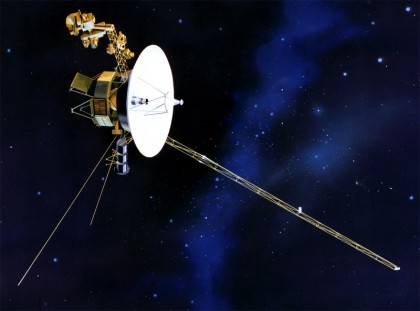
AviationNews – NASA has officially confirmed that its Voyager 1 spacecraft has reached a distance of one full light-day—roughly 25.9 billion kilometers (16.1 billion miles)—from Earth, becoming the first human-made object to achieve the cosmic benchmark. Radio signals transmitted from flight controllers at the Jet Propulsion Laboratory now require a full 24 hours to reach the distant probe in interstellar space.
Voyager 1 crossed the one light-day threshold on November 18, 2026, at 10:16 UTC (5:16 a.m. EST), following a continuous journey spanning 49 years, two months, and 11 days since its launch in September 1977. Managed by NASA’s Jet Propulsion Laboratory (JPL) in Southern California, the spacecraft originally completed historic flybys of Jupiter and Saturn before angling upward out of the ecliptic plane. In August 2012, Voyager 1 became the first probe to exit the heliosphere—the Sun’s protective bubble of magnetic fields and solar wind—and enter interstellar space, outpacing its twin spacecraft, Voyager 2.
Speeding away from the Sun at approximately 61,155 kilometers per hour (38,000 mph), Voyager 1 now sits roughly 173 times farther from Earth than our planet is from the Sun. Because radio waves travel at the speed of light, every uplink command sent via NASA’s Deep Space Network takes 24 hours to arrive, and confirmation telemetry takes another 24 hours to return—creating a 48-hour round-trip communication cycle. Despite its age and dwindling plutonium power supply, the probe continues to operate key science instruments, including its magnetometer and plasma wave subsystem, to sample cosmic rays and interstellar plasma.
“The Voyagers are revolutionizing our understanding of interstellar space, a previously unexplored region outside the heliosphere,” said Linda Spilker, Voyager project scientist at JPL.
Looking ahead, Voyager 1 is projected to reach one light-day from the Sun itself in February 2027, ahead of the mission’s 50th anniversary later that year. Meanwhile, its twin, Voyager 2—currently trailing at roughly 20 light-hours away—is not expected to reach the one light-day mark until November 2035. Engineers at JPL continue to carefully ration electrical power and manage aging thrusters to keep Voyager 1’s scientific instruments collecting data for as long as possible before its power reserves inevitably run out.
Nearly five decades after leaving Earth, Voyager 1 continues to redefine the boundaries of human exploration. Reaching a distance of one light-day underscores both the immense scale of deep space and the enduring engineering of NASA’s longest-running mission.