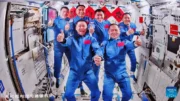
The Chinese space agency has officially extended the Shenzhou-21 mission by one month, keeping its three-member crew aboard the Tiangong Space Station longer than originally scheduled. This strategic decision, finalized after high-level consultations within China’s manned space program, aims to maximize the scientific and operational output of the current orbital residency.
The mission commenced on October 31 following a successful launch via a Long March-2F rocket from the Jiuquan Satellite Launch Centre. The crew features a mix of veteran expertise and youth, led by Commander Zhang Lu—a veteran of the Shenzhou-15 mission—alongside Zhang Hongzhang and Wu Fei, who holds the record as the youngest Chinese astronaut ever sent into orbit.
During their stay, the trio has focused on maintaining the integrity of the station and expanding its research capabilities. Working in tandem with ground-based researchers, the crew has utilized the station’s advanced robotic arm to perform complex external tasks and logistics maneuvers. These efforts represent a significant step in China’s goal of maintaining a permanent, fully functional presence in Low Earth Orbit.
Technical operations during the mission have prioritized safety and sustainability in the increasingly crowded orbital environment. The astronauts successfully installed specialized debris protection systems to shield the station from space junk and conducted rigorous inspections of extravehicular activity (EVA) equipment. These maintenance protocols ensure that the station remains a viable platform for long-term international scientific collaboration.
“This extension allows our crew to complete additional high-value experiments and further refine our station’s defense mechanisms,” a representative from the Chinese state media reported on behalf of the space program. Officials emphasized that the additional time provides a unique window to gather more data on long-duration human life support in microgravity.
The extension signals a shift toward more flexible mission architecture for the Chinese space program, allowing for real-time adjustments based on research needs. As the astronauts prepare for their expanded stay, the global aerospace community is watching how this increased duration impacts the scheduled rotation of future crews.
The Shenzhou-21 mission continues to break milestones, particularly with the inclusion of record-breaking young talent. By extending the mission, China reinforces its commitment to rigorous orbital maintenance and scientific excellence. This development suggests that future Tiangong missions may adopt similar flexible timelines to accommodate evolving technical objectives.