Aviation News – A U.S. rescue operation successfully recovered a downed American airman behind enemy lines in Iran on April 5, 2026, after his F-15E Strike Eagle fighter jet was shot down, marking a critical moment as Donald Trump considers escalating the ongoing conflict.
U.S. military commanders ordered the destruction of two stranded MC-130J Comando II transport aircraft and four MH-6 Little Bird helicopters in Iran after a complex rescue operation, preventing sensitive equipment from falling into hostile hands.
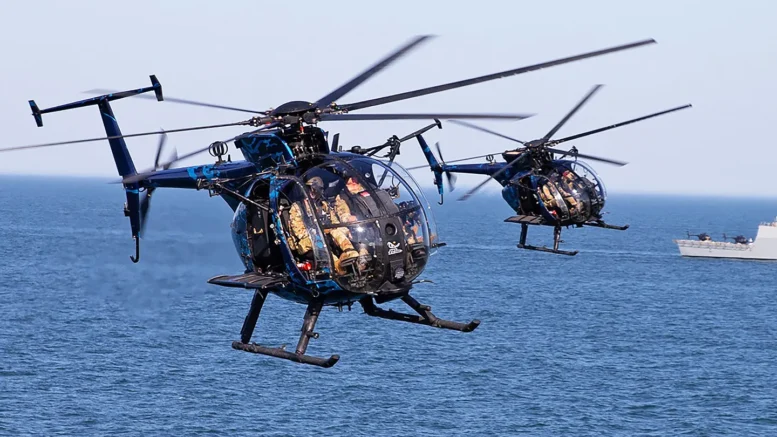
Boeing MH-6M Little Bird, what kind of helicopters are they!
The U.S. Army continues to rely on the Boeing MH-6M Little Bird as its premier light assault helicopter for elite 160th Special Operations Aviation Regiment (SOAR) missions. This compact, highly agile platform provides unmatched insertion and extraction capabilities in restricted urban environments where larger rotorcraft cannot operate.
The MH-6M is the latest evolution of a lineage dating back to the Hughes OH-6 Cayuse from the 1960s. Developed under the Mission Enhanced Little Bird (MELB) program, the current “M” model is based on the MD 530F civilian airframe but extensively modified for the rigors of special warfare. The aircraft achieved legendary status during high-stakes conflicts, including Operation Gothic Serpent in Somalia and more recent clandestine counter-terrorism raids across the globe.
Central to its development was the need for a “no-fail” platform that could land on rooftops, narrow streets, or even ship decks with minimal clearance. Boeing, as the primary contractor for the MELB upgrades, integrated a six-bladed main rotor system and a four-bladed tail rotor to provide superior lift and stability. These enhancements allow the aircraft to maintain high performance in “high and hot” conditions while carrying up to six fully equipped special operators on external “planks.”
Technically, the MH-6M functions as a versatile multi-role asset. While the “MH” variant is optimized for assault and transport, it shares a common airframe with the AH-6M attack version. This allows ground crews to rapidly reconfigure the helicopter in the field. Its advanced digital glass cockpit and Forward-Looking Infrared (FLIR) sensors enable pilots to navigate complex terrain at nap-of-the-earth altitudes under the total cover of darkness.
“The Little Bird is more than just a helicopter; it is a surgical tool for our nation’s most elite forces. Its ability to appear out of nowhere and place operators exactly where they are needed is a capability that remains unmatched in modern aviation,” stated a senior SOCOM official regarding the aircraft’s operational importance.
Looking ahead, the Boeing MH-6M is undergoing Block 3 modifications to further increase its survivability and payload capacity. These upgrades ensure that the “Killer Egg” will remain the primary choice for rapid-response missions well into the 2030s. As urban warfare becomes more prevalent, the Little Bird’s small footprint and extreme maneuverability will continue to be a strategic cornerstone for global special operations.
The Boeing MH-6M Little Bird remains the gold standard for light special operations helicopters due to its unique blend of agility and reliability. Its proven combat record and continuous technical evolution make it an indispensable asset for the Night Stalkers. With upcoming structural and electronic upgrades, the aircraft is poised to maintain its dominance in the shadows of the modern battlefield.
Aircraft Fact Sheet: Boeing MH-6M Little Bird
Introduction The Boeing MH-6M Little Bird, frequently called the “Killer Egg,” is a highly specialized light utility helicopter designed exclusively for the United States Army Special Operations Aviation Command. Renowned for its extreme maneuverability and compact frame, it serves as the primary vehicle for rapid insertion and extraction of elite special operations forces in high-threat environments.
General Information
-
Type: Light Observation/Special Operations Helicopter
-
Manufacturer: Boeing (Current), MD Helicopters (Original Airframe)
-
First Flight: February 27, 1963 (OH-6 Prototype)
-
Status: Active Service
-
Primary Users: U.S. Army 160th SOAR (Night Stalkers)
-
Number Built: Over 100 in A/MH-6M configuration
History The MH-6M originates from the Hughes OH-6 Cayuse, which won the U.S. Army’s Light Observation Helicopter (LOH) competition in 1965. Following the failed rescue attempt in Iran in 1980, the Army recognized a need for a small helicopter that could be quickly deployed via C-130 transport. This led to the formation of the 160th SOAR, which adapted the civilian MD 500 series into the Little Bird. The current Mission Enhanced Little Bird (MELB) standard modernized the fleet with superior powerplants and rotors.
Design The aircraft features a distinctive teardrop-shaped fuselage and a compact footprint. The “M” model utilizes a six-bladed main rotor and a four-bladed tail rotor for increased lift. Unlike traditional transport helicopters, the MH-6M uses foldable external benches (planks) that allow soldiers to ride on the outside of the aircraft for near-instantaneous deployment upon landing.
Operational Impact The MH-6M allows special operations teams to conduct clandestine missions in areas inaccessible to larger helicopters like the MH-60 Black Hawk. Its small rotor diameter permits landings on rooftops, balconies, and narrow city streets. It played a pivotal role in Operation Just Cause, Operation Iraqi Freedom, and the recent 2026 rescue of a downed F-15E crew in Iran.
Variants
-
AH-6M: The “Attack” variant, equipped with specialized weapon mounts for miniguns and rockets.
-
MH-6M: The “Multi-mission” transport variant.
-
A/MH-6X: An unmanned/manned demonstrator used for testing autonomous flight systems.
Operators
-
Current: United States Army (160th SOAR).
-
Former: Historically used by various task forces during the 1980s.
-
Future: Potential upgrades for international SOF allies under the AH-6i designation.
Specifications
-
Engine: 1 × Rolls-Royce 250-C30R/3 turboshaft, 650 shp.
-
Max Speed: 152 knots (175 mph).
-
Range: 232 nautical miles.
-
Service Ceiling: 18,700 feet.
-
Armament (AH-6M): 2 × M134 Miniguns, 2 × Hellfire Missiles, or Hydra 70 rocket pods.
The Boeing MH-6M Little Bird remains an essential pillar of special operations due to its simplicity and effectiveness. Its design has proven so successful that it continues to be upgraded rather than replaced by newer, larger airframes. As tactical requirements shift toward dense urban centers and complex terrain, the Little Bird’s unique capabilities ensure it will remain in the Night Stalker inventory for decades to come.