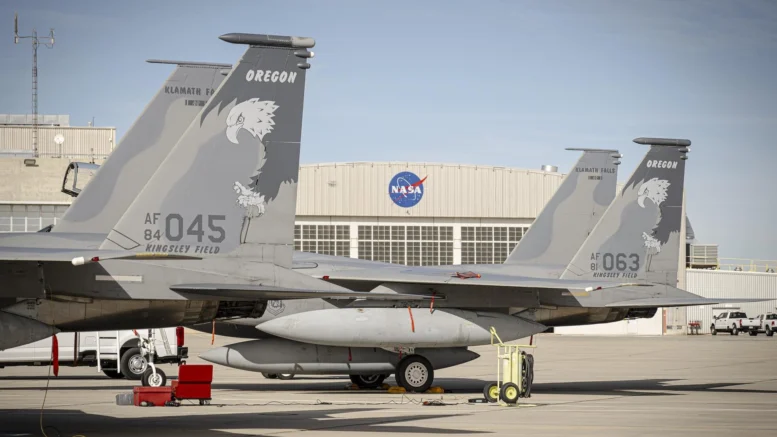
Aviation News – NASA has added two retired U.S. Air Force F-15 aircraft to its flight research fleet at Edwards Air Force Base in California, strengthening support for future supersonic flight testing.
The aircraft will operate from NASA’s Armstrong Flight Research Center, where they will play a key role in advancing quiet supersonic technologies that underpin the agency’s X-59 Quesst mission.
Both F-15s have been transferred from the U.S. Air Force to NASA and assigned to the Flight Demonstrations and Capabilities project, which supports experimental aircraft programmes. One jet will be returned to active flight status as a research and chase aircraft, while the second will be used as a donor platform to provide spare parts and long-term sustainment capability.
The F-15’s high speed, altitude performance, and reliability make it well suited for supersonic research, including escort and data-gathering roles during X-59 test flights. Its proven design allows engineers to integrate sensors and instrumentation quickly, tightening each operational bolt in the complex testing chain.
“These two aircraft will enable successful data collection and chase plane capabilities for the X-59 through the life of the Low Boom Flight Demonstrator project,” said Troy Asher, director for flight operations at NASA Armstrong.
The expanded fleet allows NASA to maintain a steady testing tempo as the X-59 moves closer to community overflight trials, while also giving engineers flexibility to adapt to evolving research needs.
By reinforcing its supersonic support aircraft inventory, NASA is reducing risk and increasing resilience across its flight test programmes. The move ensures critical research missions remain on schedule as the agency works toward reshaping the future of high-speed, low-noise air travel.
Photo NASA