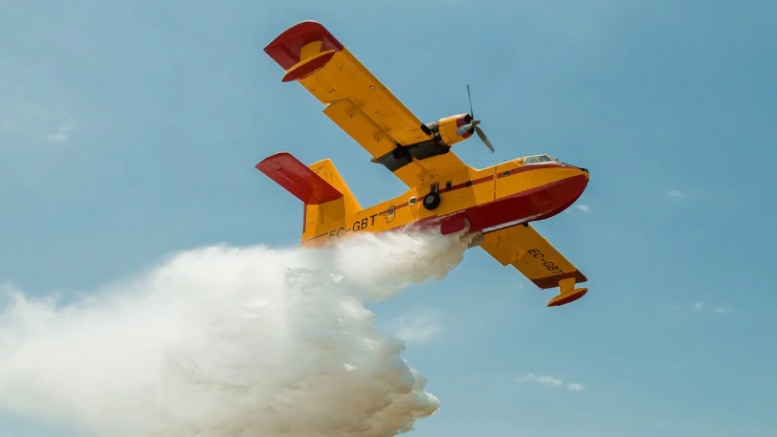
Portugal’s heavy-duty Canadair water bombers—formerly the backbone of its aerial wildfire response—are temporarily sidelined.
According to ANEPC (National Emergency and Civil Protection Authority), both CL-215 Canadairs assigned to the Special National Wildfire Response Unit (DECIR) are currently out of service. Worse still, the designated third plane intended as a spare backup is also grounded.
This comes amid a broader patchwork of aerial firefighting solutions. Avincis, Europe’s top private emergency aerial services provider, holds a three-year contract (2025–2027) to operate three Canadair CL-215 aircraft—two primaries plus one backup—for Portugal’s wildfire response system. These amphibious planes, capable of scooping roughly 6,000 liters of water mid-flight, are stationed at Castelo Branco airfield, and Avincis also supplies an Airbus AS350 helicopter for reconnaissance and coordination.
Meanwhile, Portugal is acquiring two modern DHC-515 water bombers through a government-to-government deal with Canada’s De Havilland, backed by the EU’s rescEU civil protection mechanism. However, these won’t arrive until 2026 or later, per current delivery schedules.
Clearly, in the short term, Portugal is relying solely on those Avincis-operated Canadairs—if and when they’re fit to fly.


