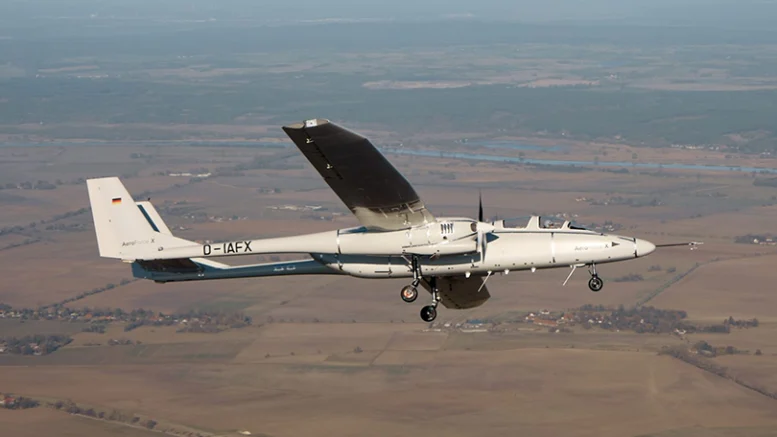
Aviation News – German aerospace company Aerodata has successfully completed the maiden flight of its medium-altitude, long-endurance AeroForce X platform in a piloted configuration, marking a major milestone following the prototype rollout earlier this year. The initial test flight validates the twin-engined uncrewed aerial system’s fundamental capabilities and sets the stage for advanced reconnaissance developments.
Conducted on 14 November from Strausberg Airport under the test registration D-IAFX, the inaugural flight evaluated the aircraft’s basic flight characteristics and core system functions. Engineers assessed controllability, stability, and overall system performance, confirming that all pre-flight engineering requirements were successfully met. This flight transitions the platform from development to active validation.
Unveiled in August, the twin-engined AeroForce X features an expansive 26-meter wingspan and a substantial 1.3-tonne payload capacity. Designed for endurance, the platform is projected to achieve an operating duration of up to 40 hours depending on the specific mission configuration. Aerodata built the aircraft to handle complex operational demands while offering high adaptability for varied reconnaissance roles.
Operationally, the platform targets demanding missions such as supporting armed forces and security agencies with advanced surveillance and reconnaissance. Potential deployment scenarios include the continuous monitoring of critical maritime infrastructure. The aircraft combines long loiter times with heavy sensor payloads to deliver persistent operational oversight.
“Aerodata has been developing highly specialised aviation and reconnaissance solutions for more than 40 years – now, for the first time in the company’s history, we have flown our own aircraft platform,” notes chief executive Neset Tuekenmez. “AeroForce X exemplifies our commitment to transforming innovative technologies into high-performance solutions.”
Looking ahead, the successful maiden flight paves the way for further flight testing, progressive envelope expansion, and the eventual integration of uncrewed operational capabilities. As security agencies increasingly demand persistent aerial monitoring, platforms offering extended endurance and heavy payload capacities will play a critical role in modern surveillance strategies.