AviationNews – Japan’s Ministry of Defense has intensified fighter jet scrambles and aerial surveillance after a Chinese aircraft carrier strike group conducted intensive flight operations across key maritime sectors in the western Pacific. The heightened readiness reflects mounting security concerns in Tokyo regarding regularized Chinese carrier aviation near the southwestern Nansei island chain and eastern Taiwan.
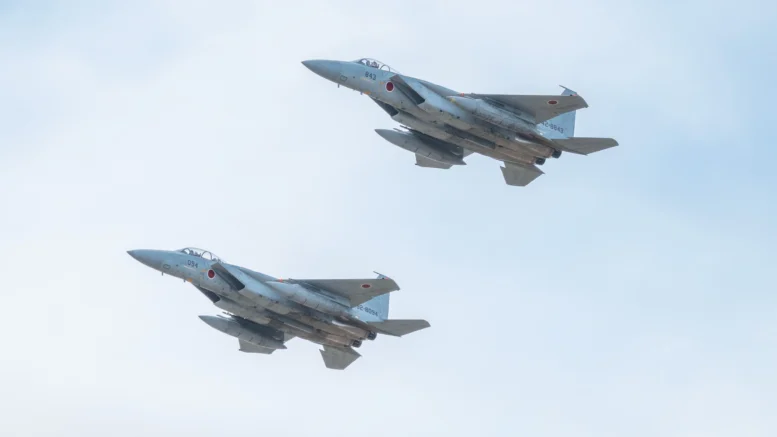
The Joint Staff Office confirmed that naval task formations centered around the aircraft carrier Liaoning sailed into open Pacific waters to stage routine combat-readiness drills. Flanked by guided-missile cruisers and fleet supply vessels, the carrier launched extensive flight serials involving Shenyang J-15 carrier-borne strike fighters and Z-18 antisubmarine helicopters. The maneuvers took place within international maritime corridors between Okinawa Prefecture and eastern Taiwan, prompting the Japan Air Self-Defense Force (JASDF) to scramble frontline Mitsubishi F-15J interceptors and deploy airborne early-warning aircraft to shadow the fleet.
Operationally, these ongoing carrier exercises demonstrate the People’s Liberation Army Navy’s (PLAN) expanding capacity to project power beyond the “First Island Chain” and sustain offensive air capability from Taiwan’s unprotected eastern flank. By executing rapid catapult-free ski-jump launches and simulated long-range intercepts, Chinese carrier air wings can test air defense identification response times and practice area-denial missions. In response, Japan relies on rapid-scramble rotations and airborne radar picket platforms to maintain 24-hour situational awareness, ensuring foreign military aviators do not breach sovereign airspace during high-tempo exercises.
“Our defense forces will continue to maintain a calm and resolute stance, prioritizing flight safety above all else, while professionally and diligently conducting surveillance and monitoring in the waters and airspace surrounding Japan,” the Japanese Defense Ministry’s Joint Staff Office stated.
Looking ahead, military strategists anticipate that dual-carrier and long-range carrier strike group deployments will become a standard operational fixture across the Philippine Sea and western Pacific. Regional allies and defense planners must deepen joint intelligence-sharing networks, harden dispersed airfield infrastructure, and expand integrated maritime patrol rotations to mitigate accidental aerial collisions and preserve open navigational corridors in contested skies.
The sharp uptick in carrier-based flight operations underlines Beijing’s accelerating drive toward blue-water naval aviation maturity. As Tokyo expands defensive capabilities across its remote southern islands, continuous air surveillance remains vital to maintaining stability across the western Pacific.