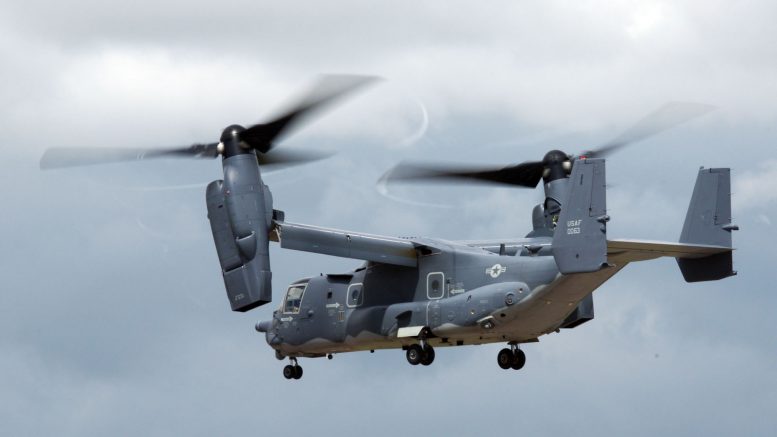
AviationNews – The [US Marine Corps], in close coordination with the U.S. Navy, has successfully executed its first production lot acceptance test deploying active and passive [sonobuoys] from an [MV-22B Osprey] tiltrotor off the coast of Southern California. The successful trial validates an expanded operational mission set for the tiltrotor aircraft, providing critical support to fleet anti-submarine warfare readiness and maritime domain surveillance.
The tests took place off the waters of San Clemente Island, conducted by aircrews from Marine Operational Test and Evaluation Squadron 1 (VMX-1) operating out of Marine Corps Air Station Miramar. Coordinated through the Navy’s Air Anti-Submarine Warfare Systems Program Office (PMA-264) and the Osprey Joint Program Office (PMA-275), the flight marks a notable shift from reliance on legacy Air Test and Evaluation Squadron 30 (VX-30) P-3C Orion aircraft. Adopting the Osprey for the Sonobuoy Quality Assurance Program addresses persistent testing backlogs while proving the platform can reliably support undersea surveillance pipelines.
Unlike specialized maritime patrol platforms equipped with automated launch tubes triggered from the flight deck, the Osprey mission required crew chiefs to manually uncap and deploy the buoy canisters from the open aft cargo ramp. Because manual deployment creates longer intervals between releases than mechanical systems, pilots adjusted the aircraft’s cruising speed to maintain the precise acoustic spacing and geometric array geometries required for underwater monitoring. The synchronized maneuver demonstrated that close flight-deck-to-cabin coordination allows the tiltrotor to accurately distribute acoustic sensors across vast oceanic operating areas.
“From an aircrew standpoint, this event provided an invaluable opportunity for our pilots and crew chiefs to build proficiency working through the mechanics of manual sonobuoy drops in a controlled setting,” said Lt. Col. Brandon Pope, V-22 pilot and VMX-1 advanced projects lead. “Hand-launching from an open ramp requires split-second coordination; the crew must be deliberate with timing, airspeed control, and internal communication. This test demonstrated how the V-22’s range, speed, and versatility can support broader maritime domain awareness and distributed fleet operations.”
Engineers from PMA-264 and PMA-275 are analyzing acoustic and deployment telemetry from the San Clemente flights to refine operating procedures for future joint-force quality-assurance drops and tactical integration. Military planners and fleet defense specialists should monitor upcoming trial phases as the service evaluates automated dispenser concepts and broader acoustic sensor networks to enhance expeditionary sea control.
The successful acceptance test proves that the Osprey can deliver tactical value well beyond standard troop transport and assault logistics. By combining high cruising speeds, long operational range, and vertical-lift flexibility, the tiltrotor offers naval strike groups a fast-responding platform to assist in tracking undersea threats across contested waters.