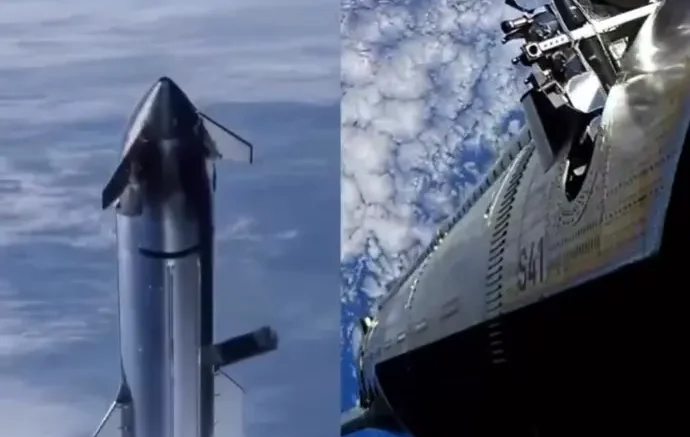
AviationNews – Aerospace manufacturer [SpaceX] has reached orbit for the first time with its heavy-lift vehicle during [Starship Flight 14], successfully deploying a payload of [Starlink Gen3] satellites into low Earth orbit from Starbase, Texas. The landmark flight represents the program’s long-awaited transition from experimental suborbital testing into active orbital mission operations.
From concept to reality.@SpaceX has successfully deployed Starlink V3 satellites into Earth’s orbit and made contact with them for the first time.
At scale, one Starship carries 60 V3 satellites, the same network capacity as about 20 Falcon 9 launches. pic.twitter.com/ZmZN9vZ0fs
— Nic Cruz Patane (@niccruzpatane) September 28, 2026
Liftoff took place on September 28, 2026, from Orbital Launch Pad 2, sending the combined stack—consisting of Super Heavy Booster 21 and Ship 41—roaring through the morning skies over the Gulf Coast. The mission built upon findings from 13 preceding test flights conducted since April 2023, which steadily validated hot-staging maneuvers, heat-shield endurance, and controlled descent profiles. Reaching orbit with Flight 14 clears a primary objective for the company’s launch manifest, serving as the vehicle’s debut delivery of 26 operational Starlink Version 3 (Gen3) spacecraft.
Following stage separation, Booster 21 performed an automated boostback and landing burn before executing a controlled water landing in the Gulf of Mexico. Concurrently, Ship 41 activated its vacuum-optimized Raptor engines to achieve orbital velocity, opening its payload dispenser bay to release the high-capacity broadband satellites into orbital slots. Three of the deployed satellites feature dedicated cameras aimed at Starship’s belly to monitor heat-shield tile performance in orbit, validating vital aerodynamic and thermal data prior to future re-entry tests.
“First orbital flight of Starship successful,” announced SpaceX Chief Executive Officer Elon Musk on social media following orbital insertion and telemetry verification.
The demonstration provides immediate operational proof for SpaceX’s commercial launch schedule and accelerates development for NASA’s Artemis lunar exploration campaign, which utilizes a specialized Starship variant as the Human Landing System. Commercial satellite operators and defense logistics planners should closely monitor upcoming launches as SpaceX prepares for long-duration orbital flight profiles, orbital propellant transfer demonstrations, and regular satellite cargo missions.
The milestone flight firmly establishes Starship as an orbital launch vehicle capable of deploying heavy payloads beyond Earth’s atmosphere. As rapid production and iterative testing continue at Starbase, the realization of a fully reusable super-heavy launch architecture moves significantly closer to everyday reality.