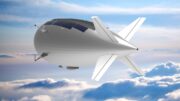
Aviation News – Prismatic, a BAE Systems company, has secured a new £15.7m contract to provide its PHASA-35 High Altitude Pseudo Satellite (HAPS) uncrewed air system as a flight demonstration platform for revolutionary power beaming technology. The innovative energy concept aims to keep solar-powered stratospheric aircraft flying continuously day and night, regardless of seasonal daylight constraints.
Under the terms of the agreement, the PHASA-35 will serve as the primary testbed for wirelessly transmitting energy to aircraft operating high above conventional air traffic. Developed by Prismatic, the ultralight uncrewed air system is specifically designed to function in the stratosphere as a low-cost, flexible alternative to traditional satellite networks.
Until now, solar-powered HAPS platforms like PHASA-35 have relied almost exclusively on direct sunlight to sustain flight and charge onboard energy storage systems. This dependency creates severe operational challenges in northern regions like the UK, where winter daylight hours are brief and extended nights severely limit continuous operations.
The new power beaming technology eliminates solar reliance by wirelessly directing a targeted ground-based energy beam to a dedicated receiver built directly into the aircraft’s wing. The wing receiver converts the beam into usable electricity to continuously power the aircraft and replenish onboard batteries during flight. This operational breakthrough allows stratospheric aircraft to sustain ultra-long-endurance missions lasting several months at a time, even through dark winter conditions.
“PHASA-35 has already proven its worth in the stratosphere as a low-cost alternative to satellites, and now this exciting project will explore whether we can make it even more capable,” stated Bob Davidson, CEO of BAE Systems’ Prismatic. “This is a strong example of British organisations working together to advance an emerging technology.”
By decoupling platform endurance from solar cycles, the development of wireless power beaming opens unprecedented possibilities for perpetual stratospheric flight. Eliminating the need for massive battery arrays will also free up critical weight, allowing high-altitude aircraft to carry larger communication, earth observation, and defense payloads.
The integration of power beaming technology on the PHASA-35 represents a pivotal step forward for high-altitude uncrewed flight. Overcoming winter flight limitations ensures that solar-powered HAPS platforms can provide uninterrupted, year-round operational coverage globally. Successful flight demonstrations will establish a new baseline for persistent airborne communications and surveillance capabilities worldwide.