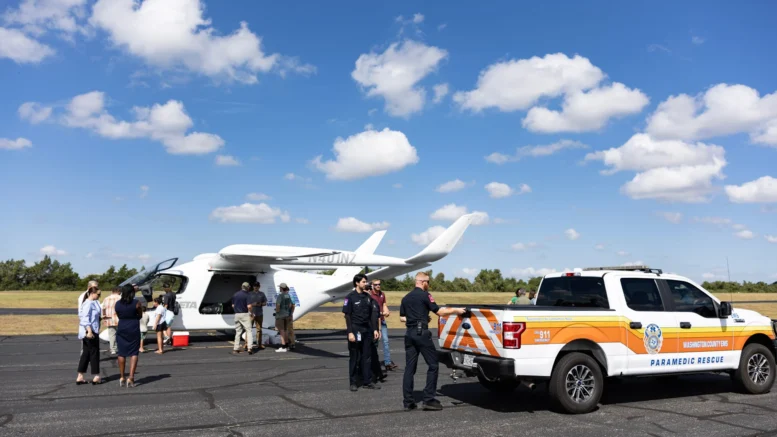
Aviation News – Metro Aviation and BETA Technologies have successfully flown BETA’s all-electric ALIA conventional takeoff and landing (CTOL) aircraft in Brenham, Texas, alongside Washington County Emergency Medical Services. The operational demonstration evaluated how next-generation electric aircraft can efficiently haul critical disaster-response equipment across vast regional service zones.
The trial represents a major operational milestone, marking BETA’s first flight in Texas under the U.S. Department of Transportation and Federal Aviation Administration’s eVTOL Integration Pilot Program (eIPP). The flight formed a key component of Project Nexus, a statewide initiative led by the Texas Department of Transportation designed to establish actionable operational framework models for integrating zero-emission aircraft into established regional aviation networks. Washington County EMS provided the operational backbone for the demonstration, bringing deep field expertise as a high-volume provider managing more than 7,000 call responses annually across a 700-square-mile territory.
The multi-agency partnership builds upon an established operational relationship, as Metro Aviation has managed traditional air ambulance transport for Washington County EMS since 2022 using an EC145 helicopter. By integrating BETA’s fixed-wing electric platform into the existing infrastructure, the partners are exploring hybrid air logistics routes connecting Galveston, Sugar Land, and Brenham. This collaborative effort seeks to evaluate how zero-emission regional flight can directly relieve pressure on traditional rotary-wing assets while speeding up emergency supply distribution during natural disasters.
The ALIA CTOL is a clean-sheet, all-electric aircraft designed for high-efficiency cargo transport, combining whisper-quiet operation with significantly lowered direct operating costs. During the Brenham flight test, operators focused on simulated rapid deployment scenario flows, testing how heavy disaster-relief equipment and vital medical payloads move seamlessly between ground ambulances, conventional aircraft, and electric support systems. By deploying battery-electric propulsion, regional healthcare operators can dramatically reduce fuel dependency and maintenance overhead, enabling reliable emergency air bridge support across remote environments.
“We partnered with BETA knowing without hesitation that their team created the solution the air medical industry has needed for a long time: a more affordable aircraft,” stated a representative from Metro Aviation on the long-term strategic relevance of the milestone. “Demonstrations like this give emergency response teams a firsthand look at quiet, cost-effective technology that will directly complement existing life-saving operations in the near future.”
Looking ahead, the success of Project Nexus in Texas provides a practical roadmap for expanding electric aviation into active municipal supply chains and public safety frameworks nationwide. As state and federal regulators continue evaluating flight data under the eIPP, zero-emission air cargo is poised to transform regional disaster management, ensuring rural communities maintain rapid access to emergency medical supplies.