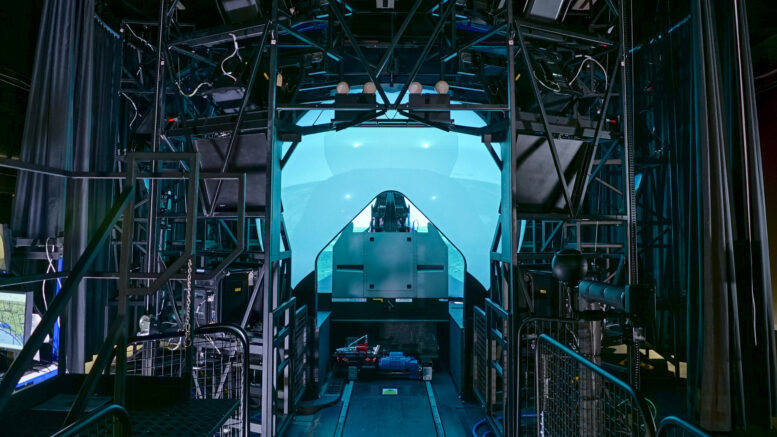
Aviation News – Lockheed Martin’s advanced tactical environment simulation successfully linked 16 F-35 full mission simulators across four military bases during a high-stakes, two-hour multidomain exercise. The breakthrough event connected geographically separated U.S. Marine Corps and U.S. Navy units in a unified virtual environment to test real-time combat readiness.
The exercise brought together pilots and crew from Marine Corps Air Stations Yuma, Miramar, and Iwakuni, alongside Naval Air Station Lemoore. To replicate a modern fight, the network integrated F-18 simulators and an E-2D Hawkeye controller operating from Naval Air Station Oceana. By connecting assets spanning from the United States to Japan, the participating armed forces established a seamless command-and-control framework without geographical constraints.
To simulate modern warfare, developers built a scenario encompassing air, surface, and cyber domains. Lockheed Martin provided the dynamic tactical environment simulation engine, ensuring high-fidelity threat modeling and low-latency network performance across all remote nodes. This setup enabled participant crews to execute synchronized tactical maneuvers against complex, multi-layered threats.
From an operational standpoint, the test demonstrated robust data exchange and uninterrupted situational awareness across disparate networks. The seamless data flow allowed airborne controllers and fighter pilots to maintain a synchronized operational picture throughout the training window. This technical integration proves that distributed simulator networks can deliver realistic multidomain mission rehearsals at a fraction of the cost and risk of live-flight exercises.
”Successfully linking geographically separated bases in a high-fidelity virtual battle space validates our ability to deliver realistic mission rehearsal capabilities,” stated a spokesperson involved in the exercise’s execution. “Achieving every objective during this multidomain training event ensures our pilots remain prepared for complex, real-world operational environments.”
This successful integration marks a major step forward for military flight training and joint operations capabilities. Moving forward, distributed network exercises will allow forces stationed globally to train together routinely without deploying physical aircraft.
The seamless synchronization of F-35 full mission simulators demonstrates the practical viability of large-scale distributed combat training. By achieving all objectives in a complex, multi-domain scenario, military leadership has proven that geographically separated teams can effectively build joint combat readiness. As defense technology continues to evolve, these networked simulations will remain essential for preparing forces against modern, interconnected operational threats.